Showing posts with label detector. Show all posts

Wednesday, November 19, 2014

Broken Charger Detector

With this circuit we can detect when charger wire was broken. This detector will work when the charger wire damage the detector will sounds an alarm warning. So we can know the charger wire is broken.


As long as there is a little current flows from the charger to battery the diodes D1 and D2 will conduct.This forward voltage drop of 1.4 V across the diodes make the Q2 ON.So the transistor Q1 will be OFF.When there is no at all any current flowing (when the wire is broken or there is a loose contact) there will not be any drop across D1&D2 and so Q2 will be OFF.This makes the Q1 ON,the buzzer beeps and the LED glows.

Tuesday, November 18, 2014

Magnetic Detector

Magnetic switch is a circuit which can respond to magnetic fields that were around the sensor. The series of magnetic switches uses sensors in the form of limit switches that provide an additional metal plate that can respond to a magnet. Magnetic switch circuit is made with an NE555 monostable multivibrator and a flip-flop togle from IC CD4013. The series of magnetic switches uses 12VDC supply voltage and the magnetic circuit is mounted indicator switch which serves to give a signal when the sensors respond to magnetic fields using the LED D1.


Click Image for full image

If the limit switches (sensors), active (connected) then it will get multivibrator NE555 triger signal and provides output pulses to be used to provide input signals to the flip-flop togle Relay K1 and active. Then when the sensors (limit switches respond to the magnetic field again, the multivibrator will give togle pulse as input to the flip-flop relay K1 and non-active.

Thursday, November 13, 2014

555 timer bassed Metal detector circuit with explanation

A very simple metal detector electronic project can be designed using a simple 555 timer integrated circuit . As you can see in the schematic circuit , this electronic project requires few external electronic parts .

This circuit detects metal and also magnets. When a magnet is brought close to the 10mH choke, the output frequency changes.
This metal detector project can be powered from a power supply that can provide an output DC voltage between 6 an 12 volt .
If a metal is closer to the L1 coil , will produce a change of output oscillation frequency, that will generate a sound in the 8 ohms speaker .

Metal

readmore: electroniq.net/other-projects/detectors/metal-detector-using-555-timer-circuit.html

Wednesday, September 24, 2014

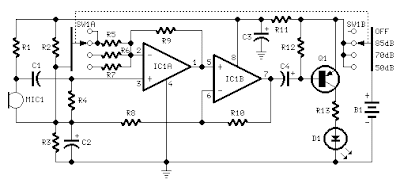
Environmental Noise Ratio Detector Circuit Diagram

This circuit is called the detector noise environment, and also indicates by means of a flashing LED when exceeding the limit specified in the environmental noise, chosen from three fixed levels. This circuit uses two operational amplifiers, in the first position SW1 circuit is not connected, positions 2, 3 and 4 define the input sensitivity threshold to 85, 70 and 50 dB, respectively.

Environmental Noise Ratio Detector Circuit Diagram

Environmental Noise Ratio Detector Circuit Diagram


Parts List

R1 = 10K
R3 R2 = 22K
R4 = 100K
R5, R9, R10 = 56K
R6 = 5K6
R7 = 560R
R8 = 2K2
R11 = 1K
R12 = 33K
R13 = 330R
C1 = 100nF
C2 = 10μF 25V
CAP 470UF 25V C3 =
C4 = 47μF 25V
D1 = LED red
IC1 = LM358
Q1 = BC327
MIC1 = Miniature electret microphone
B1 = 9V