Showing posts with label diagram. Show all posts

Thursday, November 20, 2014

Guitar Amplifier Circuit Diagram 100W

GuitarGuitar Amplifier Circuit Diagram 100W

The ability amp lath has remained banausic back it was aboriginal appear in 2002. It absolutely isn’t broken, so there’s no acumen to fix it. The photo beneath shows a absolutely accumulated lath (available as apparent as M27). Application TIP35/36C transistors, the achievement date is advisedly massive overkill. This ensures believability beneath the best backbreaking date conditions. No amplifier can be fabricated allowed from everything, but this does appear close.

The ability amp (like the antecedent version) is about based on the 60 Watt amp ahead appear (Project 03), but it has added accretion to bout the preamp. Other modifications accommodate the abbreviate ambit aegis – the two little groups of apparatus abutting to the bent diodes (D2 and D3). This new adaptation is not massively altered from the original, but has adjustable bias, and is advised to accommodate a “constant current” (i.e. aerial impedance) achievement to the speakers – this is accomplished application R23 and R26. Note that with this arrangement, the accretion will change depending on the amount impedance, with lower impedances giving lower ability amp gain. This is not a problem, so may cautiously be ignored.

Should the achievement be shorted, the connected accepted achievement appropriate will accommodate an antecedent akin of protection, but is not absolutely foolproof. The abbreviate ambit aegis will absolute the achievement accepted to a almost safe level, but a abiding abbreviate will account the achievement transistors to abort if the amp is apprenticed hard. The aegis is advised not to accomplish beneath accustomed conditions, but will absolute the aiguille achievement accepted to about 8.5 Amps. Beneath these conditions, the centralized fuses (or the achievement transistors) will apparently draft if the abbreviate is not detected in time.

Tuesday, November 18, 2014

Guitar Control Circuit Diagram

GuitarGuitar Control Circuit Diagram

Device purpose:

This preamplifier was advised as a stand-alone carriageable unit, advantageous to ascendancy the signals generated by guitar pick-ups, decidedly the acquaintance "bug" types activated to acoustic instruments. Obviously it can be acclimated with any blazon of apparatus and pick-up.

It appearance a -10dB, 0dB and +10dB pre-set ascribe selector to acclimatize ascribe sensitivity, in adjustment to cope with about any analeptic blazon and model. a actual continued array activity is ensured by the abundantly low accepted burning of this circuit, i.e. beneath than 800ยตA.

Circuit operation:

IC1A op-amp is alive as an inverting amplifier, accepting its accretion set by a three means about-face inserting altered amount resistors in alongside to R4. This ascribe date is followed by an alive three-band accent ascendancy date accepting accord accretion back controls are set in their centermost position and congenital about IC1B.

Phone Busy Indicator Diagram

PhonePhone Busy Indicator Diagram

Have you anytime been application the modem or fax and addition abroad picks up the phone, breaking the connection? Well, this simple ambit should put an end to that. It signals that the buzz is in use by lighting a red LED. When the buzz is not in use, a blooming LED is lit. It needs no alien ability and can be affiliated anywhere on the buzz line, alike army central the phone.
Notes

1. This is a very simple circuit and is easily made on a perf board and mounted inside the phone.

2. LED1 and LED2 flash on and off while the phone is ringing.

3. Do not worry about mixing up the Tip and Ring connections.

4. The ring voltage on a phone line is anywhere from 90 to 130 volts. Make sure no one calls while you are making the line connections or youll know it. :-)

5. In some countries or states you will have to ask the phone company before you connect this to the line. It might even require an inspection.

6. If the circuit causes distortion on the phone line, connect a 680 ohm resistor in between one of the incoming line wires and the bridge rectifier.

Phone Busy Indicator Diagram Part List

R1 1 3.3K 1/4 W Resistor
R2 1 33K 1/4 W Resistor
R3 1 56K 1/4 W Resistor
R4 1 22K 1/4 W Resistor
R5 1 4.7K 1/4 W Resistor
Q1, Q2 2 2N3392 NPN Transistor
BR1 1 1.5 Amp 250 PIV Bridge Rectifier
LED1 1 Red LED
LED2 1 Green LED
MISC 1 Wire, Case, Phone Cord

Thursday, November 13, 2014

Ceiling fan wiring diagram with capacitor connection

Simple Wiring diagram of ceiling fan


ceiling
Fig-1:  Ceiling fan wiring diagram

This is a simple illustrated circuit diagram of ceiling fan. To be noted that the wiring diagram is for AC 220V single phase line with single phase ceiling fan motor. Here a simple SPST switch is used to supply power or not to the fan motor and a Regulator is used to controlling the fan speed. Though it is very simple, but one thing to be noted that Switch and Regulator should be connected with the phase line of main power, not neutral.

You may like to see ceiling fan regulator circuit to controlling fan speed

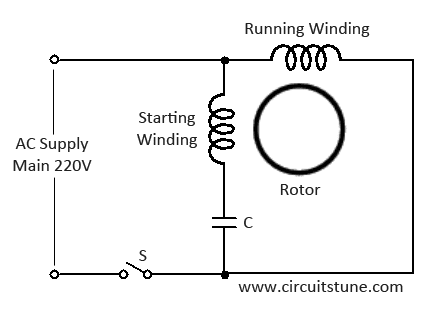
Capacitor connection diagram of ceiling fan

Ceiling fan has a “capacitor start motor” in its inside. AC single phase capacitor start motor has two winding; one is starting winding and another is running winding.

ceiling
Fig-2:  Ceiling fan capacitor connection diagram

As it is a capacitor start-capacitor run type motor; there a capacitor is used in series with Starting Winding, It defines the direction of rotation. It is an electrolytic capacitor.

Sometimes you may have faced this type of question...

  1. Why ceiling fan rotating in reverse?
  2. What makes a ceiling fan run backwards?
Two of this question sounds the same; the answer of the both question is “If capacitor is connected with running winding/main coil instead of starting winding/auxiliary coil then the direction of rotation will changed. That’s mean if you want to change the direction of rotation of the fan, just connect the capacitor with other winding.

Sunday, November 2, 2014

CAR EXTERIOR LIGHTS ELECTRONIC CIRCUIT DIAGRAM

CAR EXTERIOR LIGHTS ELECTRONIC CIRCUIT DIAGRAM

It shows the connection and wiring between each parts and component of exterior lights system of the vehicle such as the fusible link, junction block, tail light relay, cruise control, stop light switch, relay box, column switch, rear combination light, front combination light, license light, hazard light switch, turn-signal and hazard flasher unit, park/neutral position switch, back-up light switch, combination meter, and many more.

RING BELL ELECTRONIC CIRCUIT USING NE555 DIAGRAM

RING BELL ELECTRONIC CIRCUIT USING NE555 DIAGRAM

This circuit produces oscillating frequency around 1kHz, and able to be converted by changing the value of resistor R1. The speaker will produce a long beep sound with 1kHz frequency. Here is the schematic :

Parts list :

  •     Resistor R1 : 10k ohm
  •     Resistor R2 : 56k ohm
  •     Capacitor C1-C2 : 0.01 uF
  •     Polar capacitor C3 : 1 uF/15V
  •     IC timer : NE 555
  •     Speaker : 8 ohm 0.5 W
  •     ON/OFF switch
  •     5-15V Power supply

Friday, October 31, 2014

Converting a DCM Motor Circuit Diagram

We recently bought a train set made by a renowned company and just couldn’t resist looking inside the locomotive. Although it did have an electronic decoder, the DCM motor was already available 35 (!) years ago. It is most likely that this motor is used due to financial constraints, because Mรคrklin (as you probably guessed) also has a modern 5-pole motor as part of its range. Incidentally, they have recently introduced a brushless model. 

The DCM motor used in our locomotive is still an old-fashioned 3-pole series motor with an electromagnet to provide motive power. The new 5-pole motor has a permanent magnet. We therefore wondered if we couldn’t improve the driving characteristics if we powered the field winding separately, using a bridge rectifier and a 27 โ„ฆ current limiting resistor. This would effectively create a permanent magnet. The result was that the driving characteristics improved at lower speeds, but the initial acceleration remained the same. But a constant 0.5 A flows through the winding, which seems wasteful of the (limited) track power. A small circuit can reduce this current to less than half, making this technique more acceptable. 

Converting a DCM Motor Circuit diagram :


Converting
Converting a DCM Motor Circuit Diagram

The field winding has to be disconnected from the rest (3 wires). A freewheeling diode (D1, Schottky) is then connected across the whole winding. The centre tap of the winding is no longer used. When FET T1 turns on, the current through the winding increases from zero until it reaches about 0.5 A. At this current the voltage drop across R4-R7 becomes greater than the reference voltage across D2 and the opamp will turn off the FET. The current through the winding continues flowing via D1, gradually reducing in strength. When the current has fallen about 10% (due to hysteresis caused by R3), IC1 will turn on T1 again. The cur-rent will increase again to 0.5 A and the FET is turned off again. This goes on continuously.
.
The current through the field winding is fairly constant, creating a good imitation of a permanent magnet. The nice thing about this circuit is that the total current consumption is only about 0.2 A, whereas the current flow through the winding is a continuous 0.5 A. 

We made this modification because we wanted to convert the locomotive for use with a DCC decoder. A new controller is needed in any case, because the polarity on the rotor winding has to be reversed to change its direction of rotation. In the original motor this was done by using the other half of the winding.
There is also a good non-electrical alter-native: put a permanent magnet in the motor. But we didn’t have a suitable magnet, whereas all electronic parts could be picked straight from the spares box. 


Author : Karel Walraven

Saturday, October 25, 2014

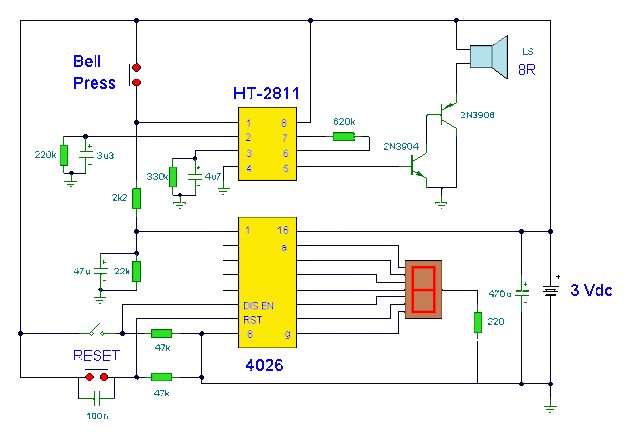
Electronic Doorbell with Counter Circuit Diagram

This circuit is a doorbell with counter, that means it counts how many times the bell is triggered. It uses a chip synthesizer sound, the HT-2811 ms nothing prevents you from using another device sound generator. The HT-2811 reproduces the sound of a "ding-dong" doorbell. Besides this ic, the circuit includes a CMOS 4026 and Display Driver IC which counts the total number of visitors.

 Electronic Doorbell with Counter Circuit Diagram


Electronic Doorbell with Counter Circuit Diagram

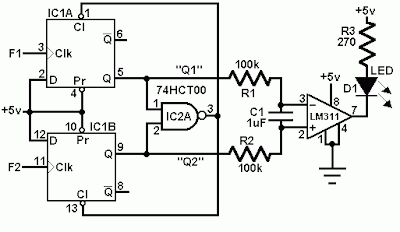
Simple Comperator Frequency LED Circuit Diagram

This Simple Comparator Frequency LED Circuit Diagram uses a comparison frequency IC 74HCT00, the device enabling frequency pulses are compared. Frequency F1 (signal frequency channel 1) and F2 (signal frequency channel 2). If the two frequencies are equal, then LED lights.


Comperator Frequency LED Circuit Diagram

Simple Comperator Frequency LED Circuit Diagram


Simple Energy Saving Switch Schematic Diagram

Lights do not always need to be on at full power. Often it would be useful to be able to turn off the more powerful lights to achieve softer illumination, but this requires an installation with two separately-switch-able circuits, which is not always available. 
 Energy-Saving Switch Circuit Image
Switch-Circuit-Image
If the effort of chasing out channels and replastering for a complete new circuit is too much, then this circuit might help. Normal operation of the light switch gives gentle illumination (LA1). For more light, simply turn the switch off and then immediately (within 1 s) on again. The circuit returns to the gentle light set-ting when switched off for more than 3 s. There is no need to replace the light switch with a dual version: simply insert this circuit between switch and lamp.

Energy-Saving Switch Circuit Diagram
Energy-saving Switch-Circuit-Diagram
Parts List:
Resistors:
R1 = 100โ„ฆ
R2 = 680โ„ฆ
Capacitor:
C1 = 4700ยตF 25 V
Semiconductors:
D1,D2 = 1N4001
Miscellaneous:
K1,K2,K3 = 2-way PCB terminal
block, lead pitch 7.5 mm
F1 = fuse, 4AT (time lag) with PCB
mount holder
TR1 = mains transformer, 12V @ 1.5
VA, short-circuit proof, PCB mount
B1 = B80C1400, round case (80V
piv, 1.4A)
RE1 = power relay, 12V, 2 x c/o,
PCB mount
RE2 = miniature relay, 12V, 2 x c/o,
PCB moun

How does it work?
Almost immediately after switch-on, fast-acting miniature relay RE2 pulls in, since it is connected directly after the bridge rectifier. Its nor-mallyclosed contact then isolates RE1 from the supply, and thus current flows to LA1 via RE1’s normally-closed con-tact. RE1 does not have time to pull in as it is a power relay and thus relatively slow. Its response is also slowed down by the time constant of R1 and C1. If the current through the light switch is briefly interrupted, RE2 drops out immediately. There is enough energy stored in C1 to activate RE1, which then holds itself pulled in via a second, normally-open, contact. If current starts to flow again through the light switch within 1s, LA2 will light. To switch LA1 back on it is necessary to turn the light switch off for more than 3 s, so that C1 can discharge via R2 and RE1. The printed circuit board can be built into a well insulating plastic enclosure or be incorporated into a light fitting if there is sufficient space.
PCB-Layout
Circuit-Diagram
Caution:
the printed circuit board is connected directly to the mains-powered lighting circuit. Every precaution must be taken to prevent touching any component or tracks, which carry dangerous voltages. The circuit must be built into a well insulated ABS plastic enclosure.Link

Thursday, October 16, 2014

Auto Anti Hijack Alarm Circuit Diagram

This Auto Anti-Hijack Alarm Circuit Diagram was designed primarily for the situation where a hijacker forces the driver from the vehicle. If a door is opened while the ignition is switched on - the circuit will trip. After a few minutes delay - when the thief is at a safe distance - the Siren will sound.

Auto

Where it differs from the first two alarms - is in what happens next. Im obliged to Victor Montanez from the USA who suggested that the engine cut-out should not operate - until the vehicle comes to a stop. That way - the engine will not fail suddenly or unexpectedly. And the hijacker will retain control.

I havent been able to implement Victors excellent suggestion completely - because I couldnt think of a simple, reliable and universally applicable way of sensing when the vehicle has come to a stop.

Instead - I have postponed engine failure until the ignition is switched off. Once the thief turns off the ignition - the engine will not re-start. Clearly - there is no certainty as to when this will occur. But I think it will occur sooner rather than later. Because theres a strong possibility that the hijacker will turn off the ignition - in an attempt to silence the siren. 

 Auto Anti-Hijack Alarm Circuit Diagram

Auto


As well as acting as a Hijack Alarm - this circuit offers some added protection. Like the Enhanced Hijack Alarm - it incorporates Jeff Chias suggestion. That is - every time the ignition is switched on - the alarm will trip. So it will protect the vehicle whenever you leave it unattended with the ignition switched off - even overnight in your driveway.

Importance
Before fitting this or any other engine cut-out to your vehicle - carefully consider both the safety implications of its possible failure - and the legal consequences of installing a device that could cause an accident. If you decide to proceed - you will need to use the highest standards of materials and workmanship.

Notes
Youre going to trip this alarm unintentionally. When you do - the LED will light and the Buzzer will give a short beep. The length of the beep is determined by C4. Its purpose is to alert you to the need to push the reset button. When you push the button - the LED will switch-off. Its purpose is to reassure you that the alarm has in fact reset. 

If the reset button is not pressed then - about 3 minutes later - both the Siren and the Buzzer will sound continuously. The length of the delay is set by R8 & C5. For extra effect - fit a second siren inside the vehicle. With enough noise going on - you may feel that its unnecessary to fit the engine cut-out. In which case - you can leave out C7, D8, R12, R13, Ty1 & Ry2.

When the ignition is switched on - C3 & R4 are responsible for tripping the alarm. By taking pin 1 low momentarily - they simulate the opening of a door. If you dont want the alarm to trip every time you turn on the ignition - simply leave out C3 & R4. 

Because the voltage on C3 may be reversed - the capacitor needs to be non-polarized. But connecting two regular 22uF capacitors back to back as shown - will work just as well. Because non-polarized capacitors are not widely available - the prototype was built using two polarized capacitors.

To reset the circuit you must - EITHER turn off the ignition - OR close all of the doors - before you press the reset button. While BOTH the ignition is on - AND a door remains open - the circuit will NOT reset.

The reset button carries virtually no current - so any small normally-open switch will do. Eric Vandel from Canada suggests using a reed-switch hidden behind (say) the dash - and operated by a magnet. I think this is an excellent idea. As Eric said in his email: - "... that should keep any thief guessing for a while."

Veroboard Layout

Veroboard
 
How you prevent the engine from starting is up to you. It should happen when Ry2 de-energizes. The contacts of Ry2 are too small to do the job themselves. So use them to switch the coil of a larger relay. Remember that the relay must be suitable for the current its required to carry. Choose one specifically designed for automobiles - it will be protected against the elements - and will give the best long-term reliability. You dont want it to let you down on a cold wet night - or worse still - in fast moving traffic!!! Remember also that you must fit a 1N4001 diode across YOUR relays coil - to prevent damage to the Cmos IC
YOUR relay should drop-out when Ry2 de-energizes. Wire YOUR relay so that when it drops-out the engine will not start. Because turning-off the ignition will cause both Ry2 and YOUR relay to de-energize - the standby current will be low - and the engine will be disabled while the vehicle is parked.
The circuit board must be protected from the elements. Dampness or condensation will cause malfunction. Fit a 1-amp in-line fuse AS CLOSE AS POSSIBLE to your power source. This is VERY IMPORTANT. The fuse is there to protect the wiring - not the components on the circuit board. Please note that I am UNABLE to help any further with either the choice of a suitable relay - or with advice on installation.
Both the Siren and the Buzzer will go on sounding until the alarm is reset. The circuit is designed to use an electronic Siren drawing up to about 500mA. Its not usually a good idea to use the vehicles own Horn because it can be easily located and disconnected. However, if you choose to use the Horn, remember that Ry1 is too small to carry the necessary current. Connect the coil of a suitably rated relay to the "Siren" output. This can then be used to sound the Horn.


Wednesday, October 15, 2014

Simple Active crossover Circuit Diagram with TL074

This is a Simple Active crossover Circuit Diagram with TL074. An audio source, like a mixer, preamp, EQ, or a recorder, is fed to the input of the Electronic Crossover Circuit. This signal is either AC or coupling, depending on the setting of switch 51, the non-inverting input of buffer amplifier Ul-a, a section of a quad BIFET, low amp TL074 noise made by Texas Instruments op. This stage has a gain of 2, and its output is distributed to both a low pass filter made by R4, R5, C2, C3, and Uld op-amp, and a high-pass filter made by R6, R7, C4, C5, and op amp ULC. 

These are12 dB / octave Butterworth filters. The response of the Butterworth filter was chosen because it gives the best compromise between the damping and phase. The values of capacitors and resistors varies depending on the selected connection that your device works. The filter outputs are fed to a balancing network made by R8, R9, RIO, R14 and potentiometer RLL balance. When the potentiometer is at its center position, there is a unity gain bandwidths for both high and low filters. Power for the electronic circuit is regulated by Crossover R12, RI3, Dl and D2, and decoupled by C6 and C7.


Active crossover Circuit Diagram with TL074


 active crossover circuit diagram with tl074

Wednesday, September 24, 2014

Piezo Buzzer Driver Circuit Diagram

  1. Buzzers are small, light, simple to use, and yet provide a loud output signal. They are either of the passive or of the active type.
  2. The former are driven by an AF signal source, while the latter feature a built-in oscillator, and require a direct voltage only. This circuit is a double AF oscillator for driving passive buzzers. It ensures a richer out- put sound than normally obtain- able from a piezo buzzer due to the use of two oscillators, N1 and N2, whose output signal lies between 1 and 10 kHz. Gates Na-N4 form an S-R bistable which is controlled by the out- puts of N1-N2, and drives the buzzer direct.
  3. Optimum effects are achieved when a simple ratio is set between the oscillator frequencies, e.g. 3:4.
  4. Piezoelectric resonators, also referred to as buzzers, are frequently used for providing audible signals in all sorts of electronic equipment.
  5. The spectral l composition of the output X signal is fairly complex, due to the presence of both the fun- damental notes and the differ- ence and sum frequency.
  6. The timbre so obtained varies as a function of the ratio between the oscillator frequencies, which are adjustable with the aid of presets P1-P2. Note that diodes D1-D2 reduce the duty factor of the oscillator signals to about 25%.
  7. The resulting waveform is always composed of rectangular signals, but these differ in respect of their period to ensure that the buzzer pro- duces a rather agreeable sound. The buzzer driver is controlled by a logic level applied to point X. The quiescent current consumption is virtually negligible, while about 10 mA is drawn in the actuated state. 
Buzzer Driver Circuit Diagram


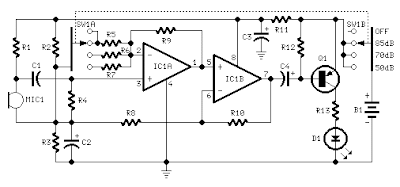
Environmental Noise Ratio Detector Circuit Diagram

This circuit is called the detector noise environment, and also indicates by means of a flashing LED when exceeding the limit specified in the environmental noise, chosen from three fixed levels. This circuit uses two operational amplifiers, in the first position SW1 circuit is not connected, positions 2, 3 and 4 define the input sensitivity threshold to 85, 70 and 50 dB, respectively.

Environmental Noise Ratio Detector Circuit Diagram

Environmental Noise Ratio Detector Circuit Diagram


Parts List

R1 = 10K
R3 R2 = 22K
R4 = 100K
R5, R9, R10 = 56K
R6 = 5K6
R7 = 560R
R8 = 2K2
R11 = 1K
R12 = 33K
R13 = 330R
C1 = 100nF
C2 = 10ฮผF 25V
CAP 470UF 25V C3 =
C4 = 47ฮผF 25V
D1 = LED red
IC1 = LM358
Q1 = BC327
MIC1 = Miniature electret microphone
B1 = 9V

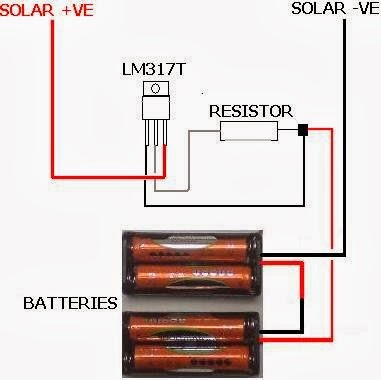
Simple Solar Battery Charger with LM317 Circuit Diagram

Simple Solar Battery Charger with LM317 Circuit Diagram. This is a solar panel battery charger schematic for AA and AAA rechargeable batteries. A small solar panel would be very good as a source of voltage charger. Building a solar AA battery charger only requires a few components and a simple construction. Solar panels should be well adapted to the battery to be charged or the battery may be overcharged. 

If you want to charge batteries with different capacities, then you need to change the solar panels. Since this is a simple solar battery charger that does not automatically turn off when the battery is full. So we need to maintain the charging current is low enough that will not damage the battery even when they are fully charged. An LM317T voltage regulator chip that can be used with a suitable resistor to regulate current. See solar AA battery charger 

 Solar Battery Charger with LM317 Circuit Diagram

 Solar Battery Charger with LM317 Circuit Diagram


Phonon Preamplifier Circuits Diagram

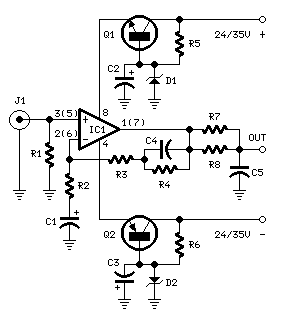
In recent years, following CDs introduction, vinyl recordings are almost disappeared. Nevertheless, a phonon preamplifier is still useful for listening old vinyl discs from a well preserved collection. This simple but efficient circuit devised for cheap moving-magnet cartridges, can be used in connection with the audio power amplifiers shown in these webpages, featuring low noise, good RIAA frequency response curve, low distortion and good high frequency transients behavior due to passive equalization in the 1 to 20KHz range. Transistors and associated components provide ±18V supply to the op-amp, improving headroom and maximum output voltage.

Phono Preamplifier Circuits Diagram
 Notes:
  • R2, R3, R4, R7, R8, C4 & C5 should be low tolerance types.
  • Schematic shows left channel and power supply.
  • For stereo operation R1, R2, R3, R4, R7, R8; J1; C1, C4 & C5 must be doubled.
  • Numbers in parentheses show IC1 right channel pin connections.

Technical data:

Sensitivity @ 1KHz: 2.5mV RMS input for 200mV RMS output
Max. input voltage @ 1KHz:120mV RMS
Max. input voltage @ 10KHz:141mV RMS
Max. input voltage @ 20KHz:127mV RMS
Frequency response @ 1V RMS output: 100Hz to 20KHz ±0.5dB; -0.75dB @ 30Hz
Total harmonic distortion @ 1KHz and 6V RMS output: 0.006%
Total harmonic distortion @10KHz and 1V RMS output: 0.02%

Parts:

R1_________47K   1/4W Resistor
R2________100R   1/4W Resistor
R3__________6K8  1/4W Resistor
R4_________68K   1/4W Resistor
R5,R6_______2K7  1/4W Resistor
R7__________2K2  1/4W Resistor
R8_________39K   1/4W Resistor
 
C1-C3_____100ยตF  25V Electrolytic Capacitors
C4,C5______47nF  63V Polyester Capacitors 5% tolerance
 
D1,D2__BZX79C18  18V 500mW Zener Diodes
 
IC1_______LM833  Low noise Dual Op-amp
 
Q1________BC337  45V 800mA NPN Transistor
Q2________BC327  45V 800mA PNP Transistor
 
J1__________RCA  audio input socket


30W Power Audio Amplifier Circuit Diagram

TIP141 si a npn silicon power darling tons designed for complementary use with TIP145, TIP146 and TP147. Can stand up to 125 W at 25°C Case Temperature, 10 A Continuous Collector Current and has a minimum hFE of 1000 at 4 V, 5 A. This home audio amplifier can output 30W with a +- 32V symmetric power supply. If you want a stereo power amplifier please check out the other schematics.


R1=1Kohm R16-17=270ohm D1=9.1V 0.4W zener
R2=47Kohm R18=22ohm 1W D2-3=1N4148
R3=1.5Kohm R19=NC Q1-2=BC550C
R4-5=10Kohm R20-21=0.39ohm 4W Q3=MPSA56
R6=5.6Kohm TR1=250ohm trimmer Q4=BC547B
R7=10ohm C1=470nF 100V MKT Q5=BC212
R8=47Kohm C2=1nF 100V MKT Q6=BC183
R9=560ohm C3=68pF ceramic Q7-8=MPSAO6
R10-11=8.2Kohm C4-8=22nF 100V MKT Q9=TIP141
R12-15=120ohm C5-6-7=100nF 100V MKT Q10=TIP146
R13=680ohm C9=47uF 25V F1-2=1.6AT FUSE
R14=330ohm C10-11=220uF 63V All the resistors is 1/4W 1% except quote differently

30W power amplifier circuit diagram

30W power amplifier circuit diagram

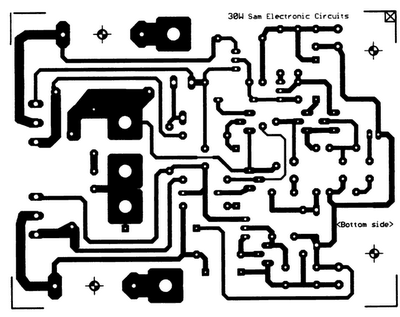
30 Watt audio amplifier PCB

30 Watt audio amplifier PCB


Simple Park Assist Circuit Diagram

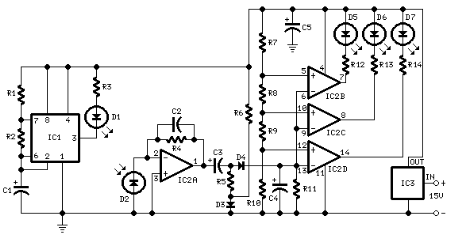
Build a  Park Assist Circuit Diagram. This is a Simple Park Assist Circuit Diagram. This Park Assist circuit was designed as an aid in parking the car near the garage wall when backing up. LED D7 illuminates when bumper-wall distance is about 20 cm., D7+D6 illuminate at about 10 cm. and D7+D6+D5 at about 6 cm. In this manner you are alerted when approaching too close to the wall. 

All distances mentioned before can vary, depending on infra-red transmitting and receiving LEDs used and are mostly affected by the color of the reflecting surface. Black surfaces lower greatly the device sensitivity. Obviously, you can use this circuit in other applications like liquids level detection, proximity devices etc. 

 Simple Park Assist Circuit Diagram


Simple Park Assist Circuit Diagram

Monitor voltage and 5VDC and 12VDC Circuit Diagram

This circuit is a voltage monitor which operates on fixed testes ± 5 VDC and ± 12 VDC, and is easily constructed as shown in Fig. It is considerably simpler than the normal display using comparators and AND gates. The circuit is not intended to indicate the level of entries. If one of the testes fail, for example, -5 V line fails, the transistor Q3 remains on but the base-emitter junction of T2 is not, so that this transistor is cut off. When this happens, there is no current through D, which then turns off.

Monitor voltage + and - 5VDC + and - 12VDC Circuit Diagram

Monitor voltage + and - 5VDC + and - 12VDC Circuit Diagram

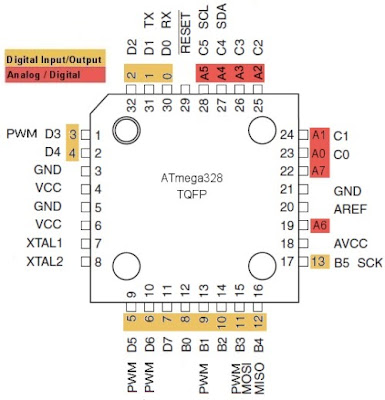
AT MEGA 328 Arduino pinout Circuit Diagram

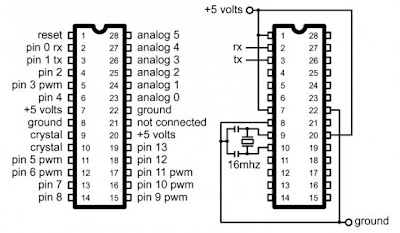
Here are diagrams that show the pinout of the micro controller Arduino Atmega and most basic circuit diagram with the crystal. Also a pinning and tqpf ATmega328 with Arduino bootloader code. Many times we lost to the passage of Arduino + breadboard to design on paper and then on the PCB.

AT MEGA 328 Arduino pinout Circuit Diagram

AT MEGA 328 Arduino pinout Circuit Diagram

Arduino bootloader


Arduino bootloader


Port B has pins B0 to B5

Port C pins have C0 to C5

Port D has pins D0 to D7

Arduino AT MEGA328 Pinout TQFP

Arduino AT MEGA328 Pinout TQFP