Showing posts with label solar. Show all posts

Saturday, October 25, 2014

Solar Lamp using the PR4403

The PR4403 is an enhanced cousin of the PR4402 40 mA LED driver. It has an extra input called LS which can be taken low to  turn the LED on. This makes it very easy  to build an automatic LED lamp using a  rechargeable battery and a solar module. The LS input is connected directly to the solar cell, which allows the module to be  used as a light sensor at the same time as  it charges the battery via a diode. When  darkness falls so does the voltage across  the solar module: when it is below a thresh-old value the PR4403 switches on. During  the day the battery is charged and, with  the LED off, the driver only draws 100 µA.
Circuit Diagram :
Solar Lamp-Circuit Diagram
Solar Lamp using the PR4403 Circuit Diagram

At night the energy stored in the battery is released into the LED. In contrast to similar designs, here we can make do with a single  1.2 V cell. The PR4403 is available in an SO-8 pack-age with a lead pitch of 1.27 mm. The  other components are a 1N4148 diode (or a Schottky 1N5819) and a 4.7 µH choke. Pin 2 is the LS enable input, connected directly to the solar module. According to the datasheet, it is possible to connect a series resistor at this point (typ. 1.2 M) to increase the effective threshold voltage. The LED will then turn on slightly earlier in the evening before it is not completely  dark. Pins 3 and 6 of the device must be connected together and together form the output of the circuit.


http://www.ecircuitslab.com/2012/08/solar-lamp-using-pr4403.html 
Wednesday, September 24, 2014

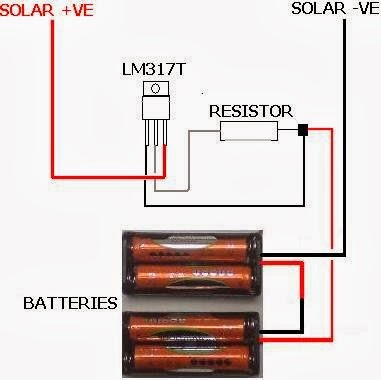
Simple Solar Battery Charger with LM317 Circuit Diagram

Simple Solar Battery Charger with LM317 Circuit Diagram. This is a solar panel battery charger schematic for AA and AAA rechargeable batteries. A small solar panel would be very good as a source of voltage charger. Building a solar AA battery charger only requires a few components and a simple construction. Solar panels should be well adapted to the battery to be charged or the battery may be overcharged. 

If you want to charge batteries with different capacities, then you need to change the solar panels. Since this is a simple solar battery charger that does not automatically turn off when the battery is full. So we need to maintain the charging current is low enough that will not damage the battery even when they are fully charged. An LM317T voltage regulator chip that can be used with a suitable resistor to regulate current. See solar AA battery charger 

 Solar Battery Charger with LM317 Circuit Diagram

 Solar Battery Charger with LM317 Circuit Diagram


How Build a Solar Charger use IC LM317

 At this point is a Solar Charger Circuit to is used to charge information Acid otherwise Ni-album batteries using the solar energy power. The circuit harvests solar energy to charge a 6 volt 4.5 Ah rechargeable battery in favor of various applications. The stallion has Voltage and Current supervision and terminated voltage restrict sour facilities.

Circuit uses a 12 volt solar panel and a changeable voltage supervisor IC LM 317. The solar panel consists of solar cells each one rated on 1.2 volts. 12 volt DC is presented from the panel to charge the battery. Charging current passes through D1 to the voltage watchdog IC LM 317. By adjusting its Adjust pin, output voltage and current can subsist regulated.

How Build a Solar Charger use IC LM317
VR is placed amid the adjust pin and ground to provide an output voltage of 9 volts to the battery. Resistor R3 confine the charging current and diode D2 prevents discharge of current from the battery. Transistor T1 and Zener diode ZD conduct yourself having the status of a stop rotten switch at what time the battery is ample. Normally T1 is rancid and battery gets charging current.
After the terminal voltage of the battery rises over 6.8 volts, Zener conducts and provides station current to T1. It followed by turns on education the output of LM 317 to prevent charging. If you want to specific voltage / current output , you can replacing ZD on the circuit above.