Showing posts with label simple. Show all posts

Tuesday, November 11, 2014

Simple 500W 12V to 220V Inverter


This is a 500W DC-to-AC inverter circuit diagram which produces an AC output at line frequency and voltage. 12VDC to 220V 50Hz inverter circuit will power 220V or 110V appliances from 12V car battery. The circuit is easy to make and is low cost. Use proper transformer. The output (in watts) is up to you by selecting different power rating transformer and power transistor rating. If you load electronic device which require 120V AC, then use transformer with 120V in output 

Sunday, November 9, 2014

simple Mobile Phone Travel Charger

At this point is an ideal cellular phone charger using 1.5 Volt ballpoint cells to charge mobile phone while wandering. It can refill cell phone battery three before four period in the field of spaces everyplace AC power is not on hand.
A good number of the cell phone phone batteries are rated by the side of 3.6 in opposition to/500 mA. A single create torch cell can provide 1.5 volts and 1.5 Amps current. So if four pen cells are connected serially, it wish form a battery bunch with 6 volt and 1.5 Amps current. while power is practical to the circuit through S1, transistor T1 conducts and grassy LED light.
What time T1 conducts T2 furthermore conducts since its dishonorable becomes denial. Charging current flows from the satellite dish of T1. To reduce the charging voltage to 4.7 volts, Zener diode ZD is used. The output gives 20 mA current on behalf of stupid charging. If additional current is essential for fast charging, reduce the denomination of R4 to 47 ohms so with the aim of 80 mA current desire live on hand. Points A and B are used to bond the steed with the itinerant phone. assistance as it should be pins meant for this and connect with correct polarity.

Sunday, November 2, 2014

Simple mixer circuit – Common base

The simple mixer schematic is built on common base principle, where input voltages are transformed in alternative currents wich are summed to form the alternative current component for the collector. The total amplification is R6 - Ri, where Ri is one of the input resistors. I’ve build this mixer for a little transmitter and works great.
Simple mixer circuit – Common base


Saturday, October 25, 2014

Simple Automatic Switch For Audio Power Amplifier


Simple Automatic Switch For Audio Power Amplifier Circuit of an automatic switch for audio power amplifier stage is presented here. The circuit uses stereo preamplifier output to detect the presence of audio to switch the audio power amplifier on only when audio is present. The circuit thus helps curtail power wastage. IC1 is used as an inverting adder. The input signals from left and right channels are combined to form a common signal for IC2, which is used as an open loop comparator. IC3 (NE556) is a dual timer. Its second section, i.e., IC3(b), is configured as monostable multivibrator. Output of IC3(b) is used to switch the power amplifier on or off through a Darlington pair formed by transistors T1 and T2. IC3(a) is used to trigger the monostable multivibrator whenever an input signal is sensed.

Circuit diagram:
Automatic Switch For Audio Power Amplifier-Circuit-Diagram
Automatic Switch For Audio Power Amplifier Circuit Diagram

Under ‘no signal’ condition, pin 3 of IC2 is negative with respect to its pin 2. Hence the output of IC2 is low and as a result output of IC3(a) is high. Since there is no trigger at pin 8 of IC3(b), the output of IC3(b) will be low and the amplifier will be off. When an input singal is applied to IC1, IC2 converts the inverted sum of the input signals into a rectangular waveform by comparing it with a constant voltage which can be controlled by varying potentiometer VR1. When the output of IC2 is high, output pin 5 of IC3 goes low, thus triggering the monostable multivibrator. As soon as the audio input to IC1 stops, pin 5 of IC3 goes high and pin 1 of IC3 discharges through capacitor C3, thus resetting the monostable multivibrator. 

Hence, as long as input signals are applied, the amplifier remains ‘on.’ When the input signals are removed, i.e., when signal level is zero, the amplifier switches off after the mono flip-flop delay period determined by the values of resistor R8 and capacitor C3. If no input signals are sensed within this time, the amplifier turns off—else it remains on. Power supply for the circuit can be obtained from the power supply of the amplifier. Hence, the circuit can be permanently fitted in the amplifier box itself. The main switch of the amplifier should be always kept on. Resistors R1 and R2 are used to divide single voltage supply into two equal parts.

Capacitors C1 and C2 are used as regulators and also as an AC bypass for input signals. Diode D1 is used so that loading fluctuations in power amplifier do not affect circuit regulation. Transisitor T2 acts as a high voltage switch which may be replaced by any other high voltage switching transistor satisfying amplifier current requirements. Value of resistor R10 should be modified for large current requirement. The LED glows when the amplifier is on. The circuit is very useful and relieves one from putting the amplifier on and off every time one plays a cassette or radio etc. 

Source : EFY

Simple Circuit Board Checker

This little circuit indicates the basic integrity of a printed board, detecting 0V, positive supply voltage from less than 3V to 30V and floating parts. If the probe is floating, as it would be in a broken track, then both LEDs barely light up, since there is no current to drive the transistors, but if the probe touches 0V or a positive voltage one or other lights. A digital signal should light them in proportion to the mark-space ratio whereas the output of a circuit oscillating at a frequency rate below about 20Hz will cause the LEDs to flicker alternatively. The LEDs will illuminate always at a constant intensity, no matter the voltage supply used, because they are fed by a very simple FET constant-current generator (Q1).

Circuit diagram:


Circuit Board Checker Circuit Diagram

 
Parts:

R1 = 22K
R2 = 22K
D1 = Red LED
D2 = Green LED
Q1 = BF245
Q2 = BC547
Q3 = BC557

Notes:
  • The Black clip must be connected to the negative ground of the board under test.
  • The Red clip should be connected to a positive voltage source (not exceeding 30V) available on the same board.
  • Metal probe is suitable for this circuit.
  • Two Miniature Crocodile Clips (Red and Black) are also necessary.

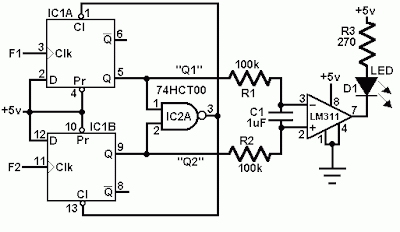
Simple Comperator Frequency LED Circuit Diagram

This Simple Comparator Frequency LED Circuit Diagram uses a comparison frequency IC 74HCT00, the device enabling frequency pulses are compared. Frequency F1 (signal frequency channel 1) and F2 (signal frequency channel 2). If the two frequencies are equal, then LED lights.


Comperator Frequency LED Circuit Diagram

Simple Comperator Frequency LED Circuit Diagram


Simple Automatic Load Sensing Power Switch

This circuit will automatically switch on several mains-powered "slave" loads when a "master" load is turned on. For example, it will switch on the amplifier and CD player in a stereo system when the receiver is turned on. It works by sensing the current draw of the "master" device through a low value high wattage resistor using a comparator. The output of that comparator then switches on the "slave" relay. The circuit can be built into a power bar, extension cord or power center to provide a convenient set of "smart" outlets that switch on when the master appliance is powered (turn on the computer monitor and the computer, printer and other peripherals come on as well).

Parts


Part            


  Total Qty.


Description


C1, C3               2               10uF 35V Electrolytic Capacitor
C2     1               1uF 35V Electrolytic Capacitor
R1     1               0.1 Ohm 10W Resistor
R2     1               27K 1/2W Resistor
R3, R4     1               1K 1/4W Resistor
R5     1               470K 1/4W Resistor
R6     1               4.7K 1/2W Resistor
R7     1               10K 1/4W Resistor
D1, D2, D4     3               1N4004 Rectifier Diode
D3     1               1N4744 15V 1 Watt Zener Diode
U1     1               LM358N Dual Op Amp IC
Q1     1               2N3904 NPN Transistor
K1     1               Relay, 12VDC Coil, 120VAC 10A Contacts
S1     1               SPST Switch 120AVC, 10A
MISC     1               Board, Wire, Socket For U1, Case, Mains Plug, Socket
Notes
  • This circuit is designed for 120V operation. For 240V operation, resistors R2 and R6 will need to be changed.
  • A maximum of 5A can be used as the master unless the wattage of R1 is increased         S1 provides a manual bypass switch.
  • THis circuit is not isolated from the mains supply. Because of this, you must exercise extreme caution when working around the circuit if it is plugged in.

A Simple Hearing Aid

Commercially available hearing aids are quite costly. Here is an inexpensive hearing aid circuit that uses just four transistors and a few passive components.


Hearing Aid Circuit Diagram


Parts:

R1 = 2.2K
R2 = 680K
R3 = 3.3k
R4 = 220K
R5 = 1.5K
R6 = 220R
R7 = 100K
R8 = 680K
C1 = 104pF
C2 = 104pF
C3 = 1uF/10V
C4 = 100uF/10V
C5 = 100uF/10V
Q1 = BC549
Q2 = BC548
Q3 = BC548
Q4 = BC558
J1 = Headphone jack
B1 = 2x1.5V Cells
SW1 = On/Off-Switch

Circuit Operation:

On moving power switch SW1 to ‘on’ position, the condenser microphone detects the sound signal, which is amplified by Q1 and Q2. Now the amplified signal passes through coupling capacitor C3 to the base of Q3.
The signal is further amplified by Q4 to drive a low impedance earphone. Capacitors C4 and C5 are the power supply decoupling capacitors. The circuit can be easily assembled on a small, general-purpose PCB or a Vero board.

It operates off a 3V DC supply. For this, you may use two small 1.5V cells. Keep switch S to ‘off’ state when the circuit is not in use. To increase the sensitivity of the condenser microphone, house it inside a small tube.

Simple Energy Saving Switch Schematic Diagram

Lights do not always need to be on at full power. Often it would be useful to be able to turn off the more powerful lights to achieve softer illumination, but this requires an installation with two separately-switch-able circuits, which is not always available. 
 Energy-Saving Switch Circuit Image
Switch-Circuit-Image
If the effort of chasing out channels and replastering for a complete new circuit is too much, then this circuit might help. Normal operation of the light switch gives gentle illumination (LA1). For more light, simply turn the switch off and then immediately (within 1 s) on again. The circuit returns to the gentle light set-ting when switched off for more than 3 s. There is no need to replace the light switch with a dual version: simply insert this circuit between switch and lamp.

Energy-Saving Switch Circuit Diagram
Energy-saving Switch-Circuit-Diagram
Parts List:
Resistors:
R1 = 100Ω
R2 = 680Ω
Capacitor:
C1 = 4700µF 25 V
Semiconductors:
D1,D2 = 1N4001
Miscellaneous:
K1,K2,K3 = 2-way PCB terminal
block, lead pitch 7.5 mm
F1 = fuse, 4AT (time lag) with PCB
mount holder
TR1 = mains transformer, 12V @ 1.5
VA, short-circuit proof, PCB mount
B1 = B80C1400, round case (80V
piv, 1.4A)
RE1 = power relay, 12V, 2 x c/o,
PCB mount
RE2 = miniature relay, 12V, 2 x c/o,
PCB moun

How does it work?
Almost immediately after switch-on, fast-acting miniature relay RE2 pulls in, since it is connected directly after the bridge rectifier. Its nor-mallyclosed contact then isolates RE1 from the supply, and thus current flows to LA1 via RE1’s normally-closed con-tact. RE1 does not have time to pull in as it is a power relay and thus relatively slow. Its response is also slowed down by the time constant of R1 and C1. If the current through the light switch is briefly interrupted, RE2 drops out immediately. There is enough energy stored in C1 to activate RE1, which then holds itself pulled in via a second, normally-open, contact. If current starts to flow again through the light switch within 1s, LA2 will light. To switch LA1 back on it is necessary to turn the light switch off for more than 3 s, so that C1 can discharge via R2 and RE1. The printed circuit board can be built into a well insulating plastic enclosure or be incorporated into a light fitting if there is sufficient space.
PCB-Layout
Circuit-Diagram
Caution:
the printed circuit board is connected directly to the mains-powered lighting circuit. Every precaution must be taken to prevent touching any component or tracks, which carry dangerous voltages. The circuit must be built into a well insulated ABS plastic enclosure.Link

Simple NiCd Battery Charger

The design of the charger is similar to that of many commercially available chargers. The charger consists of a mains adaptor, two resistors and a light-emitting diode (LED). In practical use, this kind of charger is perfectly all right. Resistor R1 serves two functions: it establishes the correct charging current and it drops sufficient voltage to light the diode. This means that the LED lights only when a charging current flows into the battery. The charging current is about 1/4 of the battery capacity, which allows a slight overcharging, and yet the charging cycle is not too long (4–5 hours).


The value of the resistors may be calculated as follows, for which the nominal e.m.f. and the capacity of the battery must be known. Adjust the output of the mains adaptor to 1.17 times the nominal battery voltage plus 3.3 V, which is the potential across R1. Note that the adaptor must be capable of supplying a current of not less than half the battery capacity. The value of R1 in ohms is equal to 3.3 divided by 1/4 of the battery capacity. The value of the resistors for various battery voltages is given in the Table. The battery capacity is taken as 1 Ah.

NiCd Battery Charger Circuit DiagramThe rating of R1 should be 5 W. If the battery to be charged has a different capacity, the theoretical value of R1 in the table must be divided by the battery capacity. Its actual value is the nearest one in the E12 series. For instance, if a 6 V battery with a nominal capacity of 600 mAh is to be charged, the value of R1 must be 20/0.6 = 33R.

Thursday, October 23, 2014

IC 2N3906 Simple signal generator circuit


This circuit is a simple signal.It can generate signals, both light and sound Alternating.Which can be applied to work. For example Taillight of bicycle or Turn left and the right of the bicycle. Etc.
When entering into power supply circuit.

by circuit will have Q1 and Q2 to be astable multi vibrator. This will work in any way ON and OFF.Or vice versa on all the time.And Pin Collection (C) of the two transistors.Connected to the light source device (LED1-LED4).For the audio source device is Buzzer BZ1.While the one ON transistor will allow the device is connected to pin C is running.The signal alternates between light and sound all the time.

Wednesday, October 15, 2014

Simple Active crossover Circuit Diagram with TL074

This is a Simple Active crossover Circuit Diagram with TL074. An audio source, like a mixer, preamp, EQ, or a recorder, is fed to the input of the Electronic Crossover Circuit. This signal is either AC or coupling, depending on the setting of switch 51, the non-inverting input of buffer amplifier Ul-a, a section of a quad BIFET, low amp TL074 noise made by Texas Instruments op. This stage has a gain of 2, and its output is distributed to both a low pass filter made by R4, R5, C2, C3, and Uld op-amp, and a high-pass filter made by R6, R7, C4, C5, and op amp ULC. 

These are12 dB / octave Butterworth filters. The response of the Butterworth filter was chosen because it gives the best compromise between the damping and phase. The values of capacitors and resistors varies depending on the selected connection that your device works. The filter outputs are fed to a balancing network made by R8, R9, RIO, R14 and potentiometer RLL balance. When the potentiometer is at its center position, there is a unity gain bandwidths for both high and low filters. Power for the electronic circuit is regulated by Crossover R12, RI3, Dl and D2, and decoupled by C6 and C7.


Active crossover Circuit Diagram with TL074


 active crossover circuit diagram with tl074

Wednesday, October 1, 2014

Simple Function Generator Circuit Using IC 555

This circuit of a simple function generator circuit explained here generates sawtooth and triangle waveforms at a frequency set by an external control voltage. Current source Ol draws a current l from timing capacitor C.
Simultaneously current source O2 draws the same current from current mirror O3, O4; this is set up (by R1 and R2) to deliver (from the collector of O4) twice the current leaving O2. Hence C receives a current 2 l from the top rail, at the same time delivering l to the bottom rail, the net effect being that the capacitor is charged by a constant current l, its voltage rising linearly until the 555s upper trigger point (at 2/3Vcc) is reached. - The output (pin 3) then goes low, as does the open~collector discharge output at pin 7.

 The latter shunts the output of the current mirror to earth, D1 becoming reverse-biased and isolating C. Now only current source O1 is connected to the timing capacitor which is now linearly discharged by current I. ln this way C is alternately charged and discharged. When the voltage on C falls to the 555s lower trigger point at 1/3Vcc, the output and discharge pins go high, and the  cycle recommences; the repetition frequency is determined by the magnitude of I, which is set by the voltage applied at the input point A. With the component values shown, the frequency range is from approx.  2.5 kHz to less than 10 Hz, as the control voltage varies from +10 V to zero; the frequency is directly proportional to the control voltage. Other ranges may be obtained by altering the value of C.


Wednesday, September 24, 2014

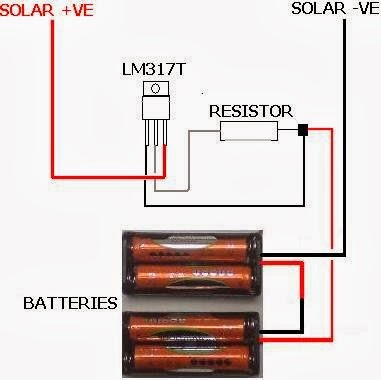
Simple Solar Battery Charger with LM317 Circuit Diagram

Simple Solar Battery Charger with LM317 Circuit Diagram. This is a solar panel battery charger schematic for AA and AAA rechargeable batteries. A small solar panel would be very good as a source of voltage charger. Building a solar AA battery charger only requires a few components and a simple construction. Solar panels should be well adapted to the battery to be charged or the battery may be overcharged. 

If you want to charge batteries with different capacities, then you need to change the solar panels. Since this is a simple solar battery charger that does not automatically turn off when the battery is full. So we need to maintain the charging current is low enough that will not damage the battery even when they are fully charged. An LM317T voltage regulator chip that can be used with a suitable resistor to regulate current. See solar AA battery charger 

 Solar Battery Charger with LM317 Circuit Diagram

 Solar Battery Charger with LM317 Circuit Diagram


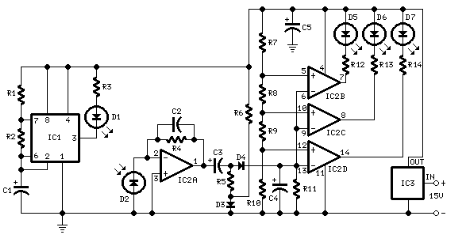
Simple Park Assist Circuit Diagram

Build a  Park Assist Circuit Diagram. This is a Simple Park Assist Circuit Diagram. This Park Assist circuit was designed as an aid in parking the car near the garage wall when backing up. LED D7 illuminates when bumper-wall distance is about 20 cm., D7+D6 illuminate at about 10 cm. and D7+D6+D5 at about 6 cm. In this manner you are alerted when approaching too close to the wall. 

All distances mentioned before can vary, depending on infra-red transmitting and receiving LEDs used and are mostly affected by the color of the reflecting surface. Black surfaces lower greatly the device sensitivity. Obviously, you can use this circuit in other applications like liquids level detection, proximity devices etc. 

 Simple Park Assist Circuit Diagram


Simple Park Assist Circuit Diagram

Simple USB Standby Killer

When turning a computer on and off, various peripherals (such as printers, screen, scanner, etc.) often have to be turned on and off as well. By using the 5-V supply voltage from the USB interface on the PC, all these peripherals can easily be switched on and off at the same time as the PC. This principle can also be used with other appliances that have a USB interface (such as modern TVs and radios). 

USB Standby Killer Circuit Diagram :
USB-Standby-Killer-Circuit Diagram

This so-called ‘USB-standby-killer’ can be realised with just 5 components.
The USB output voltage provides for the activation of the triac-opto driver (MOC3043) which has zero-crossing detection. This, in turn, drives the TRIAC, type BT126. 

The circuit shown is used by the author for switching loads with a total power of about 150 W and is protected with a 1-A fuse. The circuit can easily handle much larger loads however. In that case and/or when using a very inductive load a so-called snub-ber network is required across the triac. The value of the fuse will also need to be changed as appropriate. 

The circuit can easily be built into a mains multi-way power board. Make sure you have good isolation between the USB and mains sections (refer to the Electrical Safety page published regularly in this magazine). 


Source by : http://www.ecircuitslab.com/2012/08/usb-standby-killer.html

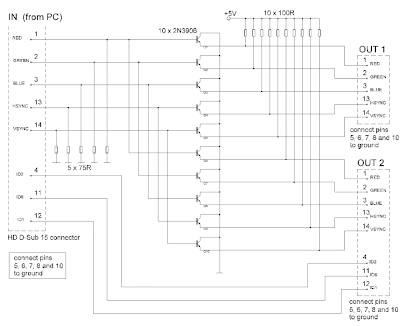
Simple VGA Monitor Splitter and Extender Circuit Diagram

The circuit was designed to provide distribution, extension and splitting of personal computer video output to two or more monitors.
  • Super Video Graphics Array (SVGA) – defined in 1989 as a set of graphic standards that supports 800 X 400 resolution or 480,000 pixels with support for 256 colors or a palette of 16 million colors.
  • Pixel – short for picture element, is the smallest point or single item of information in a graphic image and the basic unit of programmable color on a computer image or computer display.
  • 2N3906 – a common PNP BJT transistor intended for medium voltage, lower current and power, which can operate at moderately high speeds, used for general purpose switching and low-power amplifying applications.
The circuit may also be called as video port expander, multiple monitor, PC video splitter, LCD Y splitter, etc. It provides the same high resolution image to several monitors using a single PC. Each line of the SVGA card of the analog output stage of PC contains 75 ohm impedance being obtained from the signal sources.

The transistors will not contribute as additional loads as they are having very high input impedances. The parameters being shared are the primary colors which consist of Red, Green and Blue, the horizontal synchronization and the vertical synchronization. Since the three ID connections are supposed to be connected to less advance and cheaper monitors, they can be excluded in the circuit.

VGA Monitor Splitter and Extender 

VGA Monitor Splitter and Extender
 The PNP switching transistor 2N3906 forms the emitter-follower mode of ten transistors. They are utilized due to their low current having a maximum of 200 mA, low voltage with a maximum of 40 Volts, low cost, versatile and efficient, although they are not the best possible choice. It is preferable to use faster transistors when dealing with higher pixel rates because high input resistances will be supplied by higher gain.

The resolution entirely dictates the quality of a display system as to how many bits are used to represent each pixel and how many pixels it can display. To prevent RF interference on the circuit, as the monitor operates in radio frequency, a metal casing should enclose the splitter circuit and eventually be connected to ground.

The circuit will require a power supply of 5 Volts and a current around 600 mA. The DC components in the output signals will not be considered as drawbacks since the splitter is working well with 1024×768 15” and 800×600 monitors. The 2N3906 transistor is intended for amplifier functions and high-speed switching in industrial applications. Since there are many standards that have followed, all are employing the standards of SVGA since 1990 which includes the eXtended Graphics Array (XGA) of IBM, Super XGA (SXGA), SXGA+, Ultra XGA (UXGA) and Quad XGA (QXGA).

This video splitter will be suitable for tradeshows, in-store displays or classrooms where high quality video on multiple monitors is need; for support with LCD flat panel monitors and DDC2B protocol; in digital signage applications with perfect resolution; for supporting 1900×1200 resolution without degradation; for burn-in of monitors after repair; and for support of stereo audio as well.

Simple Temperature Sensor Circuit using 1N4148 diode

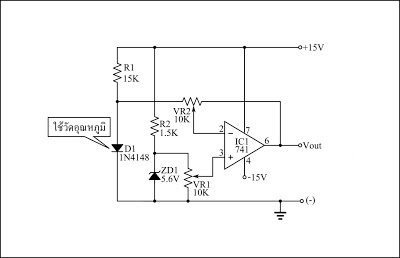
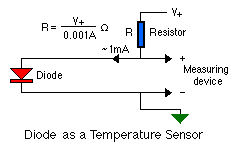
There are components that have special characteristics, one of them is the 1N4148 diode, it is a diode High-speed, and its switching speed is 4th, its voltage is 100 V and current of 450 mA. It besides a diode 1N4148 is used as the temperature sensor, that due to its characteristics that cause it to change its resistance with temperature change. Of course it does not compare to a sensor like the LM38, but for some circuits of low precision, which just need to know if an element is hot or cold it is very useful.

 Temperature Sensor Circuit using 1N4148 diode Diagram

Simple Temperature Sensor Circuit using 1N4148 diode


Using the multimeter and the 1N4148 as a thermometer

The scheme above is a circuit that measures the temperature in a simple manner using a multimeter. It uses 1N4148 diode, and VR1 and VR2 must be adjusted with a thermometer, and is more precise measurement. On the scale of the multimeter can be compared to the scale of degree Celsius with Volt.
 
   Temperature sensor with diode 1N4148
 Temperature sensor with diode 1N4148


If you liked this article,Take a few Seconds to Share this and leave comments

Simple Lead Acid Battery Charger 2

The above pictured schematic diagram is just a standard constant current model with a added current limiter, consisting of Q1, R1, and R4. The moment too much current is flowing biases Q1 and drops the output voltage. The output voltage is: 1.2 x (P1+R2+R3)/R3 volt. Current limiting kicks in when the current is about 0.6/R1 amp. For a 6-volt battery which requires fast-charging, the charge voltage is 3 x 2.45 = 7.35 V. (3 cells at 2.45v per cell). So the total value for R2 + P1 is then about 585 ohm. For a 12 V battery the value for R2 + P1 is then about 1290 ohm. 

For this power supply to work efficiently, the input voltage has to be a minimum of 3V higher than the output voltage. P1 is a standard trimmer potentiometer of sufficient watt for your application. The LM317 must be cooled on a sufficient (large) coolrib. Q1 (BC140) can be replaced with a NTE128 or the older ECG128 (same company). Except as a charger, this circuit can also be used as a regular power supply.

Lead Acid Battery Charger circuit diagramBattery ChargerBattery ChargerParts List:

R1 = 0.56 Ohm, 5W, WW
R2 = 470 Ohm C2 = 220nF
R3 = 120 Ohm
R4 = 100 Ohm
C1 = 1000uF/63V
Q1 = BC140
Q2 = LM317, Adj. Volt Reg.
C3 = 220nF (On large coolrib!)
P1 = 220 Ohm

Simple 4 Transistor Amplifier for Small Speakers

The circuit above shows a 4-transistor utility amplifier suitable for a variety of projects including receivers, intercoms, microphones, telephone pick-up coils, and general audio monitoring. The amplifier has a power isolation circuit and bandwidth limiting to reduce oscillations and "motorboating". The values are not particularly critical and modest deviations from the indicated values will not significantly degrade the performance.

Three cell battery packs giving about 4.5 volts are recommended for most transformerless audio amplifiers driving small 8 ohm speakers. The battery life will be considerably longer than a 9 volt rectangular battery and the cell resistance will remain lower over the life of the battery resulting in less distortion and stability problems.

Simple 4 Transistor Amplifier for Small Speakers

 The amplifier may be modified to work with a 9 volt battery if desired by moving the output transistors bias point. Lowering the 33k resistor connected from the second transistors base to ground to about 10k will move the voltage on the output electrolytic capacitor to about 1/2 the supply voltage.

This bias change gives more signal swing before clipping occurs and this change is not necessary if the volume is adequate. As before, the two 4.7 ohm resistors may be replaced with a single 10 ohm resistor in series with either emitter.