Showing posts with label volt. Show all posts

Tuesday, November 18, 2014

6 to 12 Volt Converter

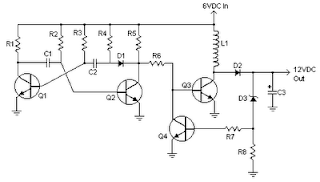
Below its a converter circuit voltage from 6 Volt to 12 Volt DC.

6
6 Volt to 12 Volt DC

Part List :
R1, R4 2 .2K 1/4W Resistor
R2, R3 4.7K 1/4W Resistor
R5 1K 1/4W Resistor
R6 1.5K 1/4W Resistor
R7 33K 1/4W Resistor
R8 10K 1/4W Resistor
C1,C2 0.1uF Ceramic Disc Capacitor
C3 470uF 25V Electrolytic Capcitor
D1 1N914 Diode
D2 1N4004 Diode
D3 12V 400mW Zener Diode
Q1, Q2, Q4 BC547 NPN Transistor
Q3 BD679 NPN Transistor
L1 See Notes
Notes
1. L1 is a custom inductor wound with about 80 turns of 0.5mm magnet wire around a toroidal core with a 40mm outside diameter.

2. Different values of D3 can be used to get different output voltages from about 0.6V to around 30V. Note that at higher voltages the circuit might not perform as well and may not produce as much current. You may also need to use a larger C3 for higher voltages and/or higher currents.

3. You can use a larger value for C3 to provide better filtering.

4. The circuit will require about 2A from the 6V supply to provide the full 800mA at 12V.

Wednesday, October 29, 2014

Transformerless 5 Volt DC Power Supply

An increasing number of appliances draw a very small current from the power supply. If you need to design a mains-powered device, you could generally choose between a linear and a switch-mode power supply. However, what if the appliance’s total power consumption is very small? Transformer-based power supplies are bulky, while the switchers are generally made to provide greater current output, with a significant increase in complexity, problems involving PCB layout and, inherently, reduced reliability.

Is it possible to create a simple, minimum part-count mains (230 VAC primary) power supply, without transformers or coils, capable of delivering about 100mA at, say, 5 V? A general approach could be to employ a highly inefficient stabilizer that would rectify AC and, utilizing a zener diode to provide a 5.1 V output, dissipate all the excess from 5.1 V to (230×√2) volts in a resistor. Even if the load would require only about 10mA, the loss would be approximately 3 watts, so a significant heat dissipation would occur even for such a small power consumption.


 At 100mA, the useless dissipation would go over 30 W, making this scheme completely unacceptable. Power conversion efficiency is not a major consideration here; instead, the basic problem is how to reduce heavy dissipation and protect the components from burning out. The circuit shown here is one of the simplest ways to achieve the above goals in practice. A JVR varistor is used for over-voltage/surge protection. Voltage divider R1-R2 follows the rectified 230 V and, when it is high enough, T1 turns on and T3 cannot conduct.

When the rectified voltage drops, T1 turns off and T3 starts to conduct current into the reservoir capacitor C1. The interception point (the moment when T1 turns off) is set by P1 (usually set to about 3k3), which controls the total output current capacity of the power supply: reducing P1 makes T1 react later, stopping T3 later, so more current is supplied, but with increased heat dissipation. Components T2, R3 and C2 form a typical ‘soft start’ circuit to reduce current spikes — this is necessary in order to limit C1’s charging current when the power supply is initially turned on. At a given setting of P1, the output current through R5 is constant.

Thus, load R4 takes as much current as it requires, while the rest goes through a zener diode, D5. Knowing the maximum current drawn by the load allows adjusting P1 to such a value as to provide a total current through R5 just 5 to 6mA over the maximum required by the load. In this way, unnecessary dissipation is much reduced, with zener stabilization function preserved. Zener diode D5 also protects C1 from over voltages, thus enabling te use of low-cost 16 V electrolytics. The current flow through R5 and D5, even when the load is disconnected, prevents T3’s gate-source voltage from rising too much and causing damage to device. In addition, T1 need not be a high-voltage transistor, but its current gain should exceed 120 (e.g. BC546B, or even BC547C can be used).

Wednesday, September 24, 2014

How to Make 12 9 Volt DC to DC Converter BD139

This circuit is a DC voltage output from a small DC input generate large voltage.It ‘s easy and quick to do, and reducing the value of the Z-diode, the circuit can be universally adapted to other output devices of the circuit voltages. The give and all diagrams represent a DC converter with 12V battery 9 volt DC input and output.
  
12-9 Volt DC to DC Converter Circuit Diagram

With the 10V zener diode, as in the diagram, the output voltage is approximately 9.3 volts DC. The supply voltage is used, should always be at least a few volts higher than the Zener voltage. In this example, I have a 12 Volt DC battery to provide regulated 9-volt DC output. Link

Precision Audio Milli volt meter Circuits Diagram

This electronic circuit is audio milivolt meter. It measures 10mV to 50Volt RMS in eight ranges.

Precision Audio Millivoltmeter Circuits Diagram

Precision Audio Millivoltmeter Circuits Diagram
 
 Notes:
  • Connect J2 and J3 to an Avo-meter set to 50µA range:
  • Switching SW2 the four input ranges will be multiplied by 5
  • Total fsd ranges are: 10mV, 50mV, 100mV, 500mV, 1V, 5V, 10V, 50V
  • Set R11 to read 1V in the 1V range, with a sine wave input of 1V @ 1KHz
  • Compare the reading with that of another known precision Millivoltmeter or with an oscilloscope.
  • The oscilloscope reading must be a sinewave of 2.828V peak to peak amplitude
  • Frequency response is flat in the 20Hz-20KHz range
  • If you have difficulties in finding resistor values for R1, R2, R3 & R4, you can use the following trick:
    R1 = 10M + 1M in parallel
    R2 = 1M + 100K in parallel
    R3 = 100K + 10K in parallel
    R4 = 1K2 + 6K8 in parallel
    All resistors 1/4W 1% tolerance 

Parts:

R1_____909K    1/2W 1% Metal Oxide Resistor
R2______90K9   1/2W 1% Metal Oxide Resistor
R3_______9K09  1/2W 1% Metal Oxide Resistor
R4_______1K01  1/2W 1% Metal Oxide Resistor
R5_____100K    1/4W Resistor
R6_______2M2   1/4W Resistor
R7______82K    1/4W Resistor
R8______12K    1/4W Resistor
R9_______1K2   1/4W Resistor
R10______3K3   1/4W Resistor
R11____200R    1/2W Trimmer Cermet
 
C1_____330nF   63V Polyester Capacitor
C2,C3__100µF   25V Electrolytic Capacitor
C4_____220µF   25V Electrolytic Capacitor
C5______33pF   63V Polystyrene Capacitor
C6_______2µ2   63V Electrolytic Capacitor
 
D1-D4___1N4148 75V 150mA Diodes
 
IC1_____CA3140 Op-amp
IC2_____CA3130 Op-amp
 
SW1_____2 poles 5 ways rotary switch
SW2_____SPDT switch
 
J1______RCA audio input socket
J2,J3___4mm. output sockets
 
B1______9V PP3 Battery
 
Clip for PP3 Battery

Simple 0 30 Volt Laboratory Power Supply

The linear power supply, shown in the schematic, provides 0-30 volts, at 1 amp, maximum, using a discrete transistor regulator with op-amp feedback to control the output voltage. The supply was constructed in 1975 and has a constant current mode that is used to recharge batteries. 

With reference to the schematic, lamp, LP2, is a power-on indicator. The other lamp (lower) lights when the unit reaches its preset current limit. R5, C2, and Q10 (TO-3 case) operate as a capacitor multiplier. The 36 volt zener across C2 limits the maximum supply voltage to the op-amps supply pins. D5, C4, C5, R15, and R16 provide a small amount of negative supply for the op-amps so that the op-amps can operate down to zero volts at the output pins (pins 6). 

A more modern design might eliminate these 4 components and use a CMOS rail-to-rail op-amp. Current limit is set by R3, D1, R4, R6, Q12, R10, and R13 providing a bias to U2 that partially turns off transistors Q9 and Q11 when the current limit is reached. R4 is a front panel potentiometer that sets the current limit, R22 is a front panel potentiometer that sets the output voltage (0-30 volts), and R11 is an internal trim-pot for calibration. The meter is a 1 milliamp meter with an internal resistance of 40 ohms. Switch S1 determines whether the meter reads 0-30 volts, or 0-1 amp. 

0-30 Volt Laboratory Power Supply Circuit diagram

 A more modern circuit might use a single IC regulator, such as the MC78XX, or MC79XX series, immediately after the half wave rectifier, to replace approximately 30 components, or at least a high precision zener diode to replace D10 as the voltage reference. The LM4040 is one such voltage reference and has excellent stability over temperature. IC regulators such as the MC78XX series may eventually become obsolete as newer IC regulators are designed, however, discrete transistors, op-amps, and zeners are more generic, have a longer production lifespan, and allow the designer to demonstrate that he understands the principles of linear regulated power supply operation.Link