Showing posts with label audio. Show all posts

Thursday, November 6, 2014

Quality Stereo Wireless Microphone or Audio Link

This stereo FM wireless microphone also makes a great quality audio link. We tested it to beyond 50 meters and it was rock solid. It’s certainly not the first wireless microphone we’ve ever published but this one is a little different. It’s stereo, providing surprisingly good quality sound. Second, it has a really good range. We tested it at well over 50m and it was still performing very well – noise-free, in fact – but at the time we couldn’t get our receiver any further away. So it’s likely to have even better range than that.

Complete Project:

main-quality-stereo-wireless-microphone-or-audio-link-circuit


quality-stereo-wireless-microphone-or-audio-link quality-stereo-wireless-microphone-or-audio-link-circuit

Its easy to build, requires very little setup... and its cheap! In fact, the low price might turn some people off, thinking its low quality. Try it - and be pleasantly surprised!

quality-stereo-wireless-microphone-or-audio-link-front

Third, it really is simple to build – the hard work (the transmitter module) is already done for you. It’s just a matter of assembling the microphone module, which contains the electret mics themselves, preamp and level controls, and soldering the transmitter module onto it, "piggy back" style.

FM Transmitter:

Finally, the transmitter module is crystal-locked, so you won’t have the drift probles of some earlier wireless microphones. And just in case you were wondering, that doesn’t mean the output is locked to one particular frequency – it has a nifty synthesis circuit built in to give you the choice of seven different frequencies between 106.7MHz and 107.7MHz.

On-board preset pots adjust the sensitivity of each channel to take into account mic differences or if you require different levels in each channel.

fm-transmitter-module-top-side-view

By the way, the transmitter module is quite capable of operating at line level if you want just a line level transmitter (eg, to feed an audio program around your home). Sensitivity is about 100mV. Oatley Electronics, who designed the kit, have the transmitter module available by itself if that’s what you’re after. But more on that anon.

fm-transmitter-module-bottom-side-view

Parts Layout:

parts-layout-quality-audio-link-circuit-diagram
parts-layout-of-quality-stereo-wireless-microphone-or-audio-link

You also have the choice of two power supply levels – 3-6V or 7-15V DC. The latter results in a lower current drain. The transmitter module also has a "5V out" rail to supply power to the preamp module.

Circuit Diagram:

quality-stereo-wireless-microphone-or-audio-link-circuit-diagram

Two electret microphone inserts are supplied in the kit. These can be soldered direct to the PC board to make it a fully self-contained project or they can be attached to the board via suitable lengths of mini shielded coax cable. A third option is to use "proper" microphones – they can be electret or dynamic types – but no provision has been made for plugging these in.

Typical Specifications: 
 
Audio response:.....................20Hz-15kHz.
Channel separation: ........................40dB
Total Harmonic Distortion: ...............0.1%
Output Frequency:...........106.7-107.2MHz
Pre Emphasis: ..................................50μS
DC supply voltage range: ................3-15V
Supply Current: .......................30mA @ 9V


Wednesday, November 5, 2014

1W BTL Audio Amplifier

The TDA8581(T) from Philips Semiconductors is a 1-watt Bridge Tied Load (BTL) audio power amplifier capable of delivering 1 watt output power into an 8-Wload at THD (total harmonic distortion) of 10% and using a 5V power supply.

The schematic shown here combines the functional diagram of the TDA8551 with its typical application circuit. The gain of the amplifier can be set by the digital volume control input. At the highest volume setting, the gain is 20 dB. Using the MODE pin the device can be switched to one of three modes: standby (MODE level between Vp and Vp–0.5 V), muted (MODE level between 1 V and Vp–1.4 V) or normal (MODE level less than 0.5 V). The TDA8551 is protected by an internal thermal shutdown protection mechanism. The total voltage loss for both MOS transistors in the complementary output stage is less than 1 V.

1 Watt BTL Audio Amplifier Circuit Diagram:

1


Using a 5-V supply and an 8-W loudspeaker, an output power of 1 watt can be delivered. The volume control has an attenuation range of between 0 dB and 80 dB in 64 steps set by the 3-state level at the UP/DOWN pin: floating: volume remains unchanged; negative pulses: decrease volume; positive pulses: increase volume Each pulse at he Up/DOWN pin causes a change in gain of 80/64 = 1.25 dB (typical value).

When the supply voltage is first connected, the attenuator is set to 40 dB (low volume), so the gain of the total amplifier is then –20 dB. Some positive pulses have to be applied to the UP/DOWN pin to achieve listening volume. The graph shows the THD as a function of output power. The maximum quiescent current consumption of the amplifier is specified at 10 mA, to which should be added the current resulting from the output offset voltage divided by the load impedance.


Boomer Audio Power Amplifier Using LM4906

The well-known LM386 is an excellent choice for many designs requiring a small audio power amplifier (1-watt) in a single chip. However, the LM386 requires quite a few external parts including some electrolytic capacitors, which unfortunately add volume and cost to the circuit.

National Semiconductor recently introduced its Boomer® audio integrated circuits which were designed specifically to provide high quality audio while requiring a minimum amount of external components (in surface mount packaging only). The LM4906 is capable of delivering 1 watt of continuous average power to an 8-ohm load with less than 1% distortion (THD+N) from a +5 V power supply. The chip happily works with an external PSRR (Power Supply Rejection Ratio) bypass capacitor of just 1 µF minimum.

In addition, no output coupling capacitors or bootstrap capacitors are required which makes the LM4906 ideally suited for cellphone and other low voltage portable applications. The LM4906 features a low-power consumption shutdown mode (the part is enabled by pulling the SD pin high).

Additionally, an internal thermal shutdown protection mechanism is provided. The LM4906 also has an internal selectable gain of either 6 dB or 12 dB. A bridge amplifier design has a few distinct advantages over the single-ended configuration, as it provides differential drive to the load, thus doubling output swing for a specified supply voltage. Four times the output power is possible as compared to a single-ended amplifier under the same conditions (particularly when considering the low supply voltage of 5 to 6 volts).

Boomer Audio Power Amplifier Circuit Diagram:


When pushed for output power, the small SMD case has to be assisted in keeping a cool head. By adding copper foil, the thermal resistance of the application can be reduced from the free air value, resulting in higher PDMAX values without thermal shutdown protection circuitry being activated. Additional copper foil can be added to any of the leads connected to the LM4906. It is especially effective when connected to VDD, GND, and the output pins. A bridge configuration, such as the one used in LM4906, also creates a second advantage over single-ended amplifiers. Since the differential outputs, Vo1 and Vo2, are biased at half-supply, no net DC voltage exists across the load.

This eliminates the need for an output coupling capacitor which is required in a single supply, single-ended amplifier configuration. Large input capacitors are both expensive and space hungry for portable designs. Clearly, a certain sized capacitor is needed to couple in low frequencies without severe attenuation. But in many cases the speakers used in portable systems, whether internal or external, have little ability to reproduce signals below 100 Hz to 150 Hz. Thus, using a large input capacitor may not increase actual system performance. Also, by minimizing the capacitor size based on necessary low frequency response, turn-on pops can be minimized.


Sunday, November 2, 2014

Tiny Audio Amplifiers Using LM386 and NE5534

Many electronic projects require the use of a small audio amplifier. Be it a radio transceiver, a digital voice recorder, or an intercom, they all call for an audio amp that is small, cheap, and has enough power to provide adequate loudness to fill a room, without pretending to serve a disco! About one Watt RMS seems to be a convenient size, and this is also about the highest power that a simple amplifier fed from 12V can put into an 8 Ohm speaker. A very low saturation amplifier may go as high up as 2 Watt, but any higher power requires the use of a higher voltage power supply, lower speaker impedance, a bridge circuit, or a combination of those.

During my many years building electronic things I have needed small audio amps many times, and have pretty much standardized on a few IC solutions, first and and foremost the LM386, which is small, cheap, and very easy to use. But it does not produce high quality audio... For many applications, the advantages weigh more than the distortion and noise of this chip, so that I used it anyway. In other cases I used different chips, which perform better but need more complex circuits. Often these chips were no longer available the next time I needed a small amplifier.

When I last upgraded my computer, I replaced the old and trusty Soundblaster AWE 32 by a Soundblaster Audigy. The new card is better in many regards, but while the old one had an internal audio power amplifier, the new one doesnt! Thats bad news, because I have some pretty decent speakers for the PC, which are fully passive. So, I built a little stereo amp using two LM386 chips and installed it inside the computer, fed by the 12V available internally.

But then I wasnt satisfied. The LM386 might be suitable for "communication quality" audio, which is roughly the fidelity you get over a telephone, but for music its pretty poor! The distortion was awful. So, the day came when I decided to play a little more scientifically with small audio amps, looking for a way to get good performance with simple and inexpensive means.

I set up a test bench with a sine wave oscillator running at 1 kHz, an 8 Ohm speaker, 12V power supply, and the computer with the soundcard and Fast Fourier Transform software. One channel was connected to the oscillator together with the amplifier input, the other channel to the output and speaker. With this setup I measured the harmonic content of the audio signals. I did the tests at an output level of 0.1W, which is typical for moderately loud sound from a reasonably efficient speaker. Also, I used a music signal from a CD player to test the actual sound of each amplifier.


As already said above, the main attraction of the LM386 is the extreme simplicity of its application circuit. You can even eliminate R1 if the signal source is DC-grounded. If the speaker leads are long, you should add an RC snubber across the output to aid stability. Additionally, if you need higher gain (not necessary if the input is at line level), you can connect a 10uF capacitor between pins 1 and 8. Thats about all there is to it.

Now the bad news: This circuit produced a very high level of distortion! The second harmonic measured just -28dB from the main output. The third harmonic was at -35dB, while the noise level was at -82dB. There were assorted high harmonics at roughly -45dB. With music, the distortion was really disturbing, and also the noise level was uncomfortably high. The power supply rejection is poor, so that some hum and other supply noise gets through. In short, this was a lousy performance!

Since I had used so many LM386s in my projects, I had several different variations. In my material box I found a slightly newer LM386N-1. So I plugged it into my test amplifier. It was even worse! The second harmonic was at -24dB, the third harmonic at -31dB, while the noise was a tad better at -84dB. Folks, thats a total harmonic distortion of almost 7%! And the 0.1W output level at which this was measured is where such a circuit is about at its best...  The distortion can be plainly seen on the oscilloscope, and a visibly distorted waveform is about the most offending thing an audio designer can ever see!

Looking through my projects, I found one where I had used a GL386 chip. This is just a 386 made by another company. I unsoldered it and put it in my test amplifier. Surprise! It was dramatically better, with the second harmonic at -45dB, and the third at -57dB! The noise floor was -84dB, just like the LM386N-1. But even this level of distortion was plainly audible when listening to music. Thats roughly 0.6% THD. Some folks may consider it acceptable for music. I dont, but for communication equipment its fine. At this point, I decided to see if I could build a better amplifier, that doesnt become too complex nor expensive.


This was the first attempt. A low distortion, fast slew rate, but easy to find and rather inexpensive operational amplifier, driving a simple source follower made of two small transistors. These transistors are not biased, so they work at zero quiescent current, in full class B. The only mechanism that works against crossover distortion here is the high slew rate of the OpAmp, which is able to make the distortion bursts during crossover very short. To say the truth, I didnt expect to get usable performance from this circuit, and was really surprised when it worked much better than the 386! The second harmonic was at -77dB, the third at -79dB!

Also there were many high harmonics at roughly -84dB. That means a THD of about 0.015%.  The noise floor was down at the -120dB level! The power supply rejection was excellent, with no detectable feedtrough. Playing music, this amplifier sounded really good: No audible noise, and the distortion could be heard when paying attention to it, but I doubt that the average person would detect it! Not bad, for a bias-less design!

Just to see how important the slew rate of the OpAmp is, I pulled out the NE5534 and replaced it by a humble 741, which is many times slower. The result was dramatic: The second harmonic still good at -70dB, but the third harmonic was much worse, at -48dB. Also there were many high harmonics at the same -48dB level. Given that second harmonic distortion doesnt sound bad to most people, but third harmonic does, and high harmonics are even worse, it came as no surprise that the amplifier with the 741 sounded bad.

At low volume it sounded particularly bad! So I returned to the oscillator and measurement setup, testing at lower output power, and found that while the second and third harmonics followed the output, the high harmonics stayed mostly constant! So, at very low output, the high harmonics became very strong relative to the output. All this is the effect of the slower slew rate of the 741, which makes it less effective correcting the crossover distortion of the unbiased transistors. Interestingly, the noise floor of the 741 circuit wasnt bad: -118dB.

Just for fun, I tried this circuit with a third OpAmp: The TL071, which is good, but not as good as the 5534. The results: Second harmonic at -72dB, third and the high ones at -60dB, and the noise at -120dB. Its interesting that the second harmonic is much more suppressed than the third one. That must be a balancing effect of the symmetric output stage, and the better symmetry in the TL071 compared to other OpAmps.

Its worthwhile to note that this amplifier can be simplified a lot by using a split power supply. R1, R2, C1, C2 and C4 would be eliminated! But then you need the capacitor removed from C4 to bypass the negative supply line. The positive input of the chip goes to ground, while pin 4 and the collector of Q2 go to the negative supply. The rest stays the same. If you use a +-15V supply, the available RMS output power grows to over 10 Watt! Of course, you then need larger transistors. And since larger transistors are slower, the distortion will rise somewhat. An added benefit of a split supply is that the popping noise when switching on and off is eliminated.


As the next experiment, I decided to get rid of the crossover distortion. For this purpose, I added a traditional adjustable bias circuit with a transistor and a trimpot. Now I also had to add a current source, because with the bias circuit there is no single point into which the OpAmp could put its drive current into both bases! I adjusted the bias for the best distortion, and this was really  a good one! The second harmonic was down right where the test oscillator delivered it, about -80dB, so I couldnt really measure it!

The third harmonic was at -84dB, and the best improvement was that the higher harmonics had simply disappeared! They were all below the noise floor, which stayed at -120dB. Actually, this noise floor seems to come from the soundcard A/D converter, so that the actual noise of this and the above amplifier may even be better! With music, this amplifier sounded perfect - clean and smooth. And Im pretty confident that the THD is well below the limits of my measurement setup, which is 0.01%.

The quiescent current was around 10mA. When lowering it to about 3mA, the high harmonics started to rise out of the noise floor. If you want to adjust the bias for the exact best quiescent current, there is a simple trick: Lift R4 from the output, and connect it to pin 6. Now the output stage has been left outside the feedback loop, and all its distortion will show up at the output. Watching the signal on an oscilloscope, or even better on a real time spectrum analyzer (soundcard and software), adjust the trimpot to the lowest distortion level.

Have a current meter in the supply line and make sure that you dont exceed 30mA or so of quiescent current, in order to keep the small transistors cool. But most likely the best distortion will be at a current lower than that. Once the adjustment is complete, return R4 to its normal position. Now the full gain and slew rate of the operational amplifier is used to correct the small remaining cross-over distortion of the output stage, and the distortion will certainly disappear from the scope screen, from your ears, and possibly fall below the detection level of the spectrum analyzer!

This circuit can also be run from a split power supply, by exactly the same mods as for the previous circuit. And since the transistors are properly biased, there isnt any significant distortion increase when using larger transistors. Be sure to use some that have enough gain - you have only a few mA of driving available, and with a +-15V power supply and an 8 Ohm speaker, there can be almost 2A of output current! So, you need a gain of 300 at least. There are power transistors in the 4A class that provide such gain, and these are good candidates. The other option is using Darlington transistors, which far exceed the gain needed here. But they will again increase the distortion, not very much, but perhaps enough to make it audible again.


Source: Humo Luden

Thursday, October 30, 2014

Car Audio Amplifier Instalation Guide

Amplifier and speakers wiring. The amplifier does not always come with wire connection. You need a kit amp wiring harness sold separately. It is important to adjust the harness to the vehicle you have, to the right frequency and sound. The red wires (positive) is thicker than black (ground). A 12 -, 10 – or 8-gauge wire or lower is better sound quality.

Car

Connecting the power cable and head unit. Disconnect the negative battery cable car, then the positive. Connect the red amplifier (positive) to the positive battery cable. Strip one end of the thread about half an inch and squeeze the cable connector U-Connect the positive terminal of the battery and tighten. Slide the other end through the firewall of your car, which is located towards the rear under the hood. Drag the interior and on the back of the torso. You may need to unscrew the bottom plate on each side and pull the seat back to move the thread. Black lead to an O-ring and screws for the metal of the cars to squeeze into the trunk.

Check if your head unit has suspended two AV, the ends of the women. If not, you have to buy one and have it installed. AV wire supplied with the kit must be long enough to reach from the amplifier in the trunk of the radio. Connect the ends of the red and white male to the female ends of the amplifier and the radio. Then connect the son of the subwoofer amplifier. Connect the negative terminal of the battery.

Turn the key to your car and listen to the radio at low volume. Not at full power crank. You get a distorted sound, or a speaker can blow the air. You will feel the vibration in the car audio system.

Monday, October 27, 2014

2 x 22W BTL Car Audio Amplifier DA1553CQ

This is a 22 Watt car stereo audio amplifier. The circuit is based by a single IC TDA1553 with a few peripheral components, this IC hope against hope code name your stereo car audio classification. The IC TDA1553CQ contains 2×22 W amplifiers with differential input stages and can exist used in favor of connection applications.. The expansion of apiece amplifier is fixed by the side of 26 dB. The device is primarily residential for car broadcasting applications.

Circuit Diagram 2 x 22W-BTL Car Audio Amplifier Using DA1553CQ

Circuit Diagram 2 x 22W-BTL Car Audio Amplifier Using TDA1553CQ 
  • The TDA1553CQ IC have got to be present fitted with adequately sized cook sinks.
  • unite a 10K POT happening string with the input because volume control if you need. Not publicized in circuit diagram.
  • employment 12V DC in favor of powering the circuit.


What time a diminutive-circuit to ground occurs, which forces a DC voltage across the loudspeaker of >= vs., a built-in protection circuit becomes full of life and limits the DC voltage across the loudspeaker to <= vs.. pin 12 detects the status of the protection circuit (e.g. meant for diagnostic purposes).

If slightly output is unfriendly-circuited to ground in the course of the side with mode, it becomes hopeless to switch the circuit to the mute otherwise operating condition. happening this event the supply current determination remain some degree of to a little milliamps.

Sunday, October 26, 2014

LM2876 40W audio power amplifier Diagram Circuit

Using the LM2876 high-performance audio power amplifier circuit can be designed a very simple high efficiency power audio amplifier electronic project capable of delivering 40W of continuous average power to an 8Ω load with 0.1% THD+N from 20Hz–20kHz.
The performance of the LM2876 high-performance audio power amplifier, utilizing its Self Peak Instantaneous Temperature (°Ke) (SPiKe™) protection circuitry, puts it in a class above discrete and hybrid amplifiers by providing an inherently, dynamically protected Safe Operating Area (SOA). SPiKe protection means that these parts are completely safeguarded at the output against overvoltage, undervoltage, overloads, including shorts to the supplies, thermal runaway, and instantaneous temperature peaks.
The LM2876 maintains an excellent signal-to-noise ratio of greater than 95dB (min) with a typical low noise floor of 2.0μV.

As you can see in the circuit diagram , this 40W high-performance audio power amplifier electronic project require few external electronic parts and require few knowledge .
The muting function of the LM2876 allows the user to mute the music going into the amplifier by drawing less than 0.5 mA out of pin 8 of the device.
Upon system power-up the under-voltage protection circuitry allows the power supplies and their corresponding caps to come up close to their full values before turning on the LM2876 such that no DC output spikes occur.
The LM2876 contains overvoltage protection circuitry that limits the output current to approximately 4Apeak while also providing voltage clamping, though not through internal clamping diodes.
The LM2876 has a sophisticated thermal protection scheme to prevent long-term thermal stress to the device. When the temperature on the die reaches 165°C, the LM2876 shuts down. It starts operating again when the die temperature drops to about 155°C
The LM2876 high-performance audio power amplifier circuit operates over a wide input voltage range , from 20 up to 70 volts , but typically a dual 30 volt power supply ( or a single 60 volt in this case ) will be work fine

Multi channel audio systems

Multi-channel audio systems are widely used within novel sound campaign. The word “multi-channel audio” process with the intention of, the audio method can transpire accomplished of conduct multiple audio channels (more often than not called audio tracks) to rebuild the sound on a multi-loudspeaker setup.
Usually two digits separated by a decimal (.) end (2.1, 4.1, 5.1, 6.1, 7.1, and the rest.) are used to classify the various kinds of orator fix-up, this total basically depending on how many audio tracks are used. about audio systems solitary suffer a single channel (called monophonic sound otherwise single channel audio) or two channels (stereophonic sound or else 2.0 channel sound)
The initial numeral shows the quantity of primary channels (called satellite units), both of which are reproduced on a single presenter (these speakers are accomplished in place of use the frequency range from 100Hz to 22Khz), while the back up (decimal figure) refers to the presence of LFE (Low Frequency Effect), which is reproduced on a subwoofer.

Saturday, October 25, 2014

Simple Automatic Switch For Audio Power Amplifier


Simple Automatic Switch For Audio Power Amplifier Circuit of an automatic switch for audio power amplifier stage is presented here. The circuit uses stereo preamplifier output to detect the presence of audio to switch the audio power amplifier on only when audio is present. The circuit thus helps curtail power wastage. IC1 is used as an inverting adder. The input signals from left and right channels are combined to form a common signal for IC2, which is used as an open loop comparator. IC3 (NE556) is a dual timer. Its second section, i.e., IC3(b), is configured as monostable multivibrator. Output of IC3(b) is used to switch the power amplifier on or off through a Darlington pair formed by transistors T1 and T2. IC3(a) is used to trigger the monostable multivibrator whenever an input signal is sensed.

Circuit diagram:
Automatic Switch For Audio Power Amplifier-Circuit-Diagram
Automatic Switch For Audio Power Amplifier Circuit Diagram

Under ‘no signal’ condition, pin 3 of IC2 is negative with respect to its pin 2. Hence the output of IC2 is low and as a result output of IC3(a) is high. Since there is no trigger at pin 8 of IC3(b), the output of IC3(b) will be low and the amplifier will be off. When an input singal is applied to IC1, IC2 converts the inverted sum of the input signals into a rectangular waveform by comparing it with a constant voltage which can be controlled by varying potentiometer VR1. When the output of IC2 is high, output pin 5 of IC3 goes low, thus triggering the monostable multivibrator. As soon as the audio input to IC1 stops, pin 5 of IC3 goes high and pin 1 of IC3 discharges through capacitor C3, thus resetting the monostable multivibrator. 

Hence, as long as input signals are applied, the amplifier remains ‘on.’ When the input signals are removed, i.e., when signal level is zero, the amplifier switches off after the mono flip-flop delay period determined by the values of resistor R8 and capacitor C3. If no input signals are sensed within this time, the amplifier turns off—else it remains on. Power supply for the circuit can be obtained from the power supply of the amplifier. Hence, the circuit can be permanently fitted in the amplifier box itself. The main switch of the amplifier should be always kept on. Resistors R1 and R2 are used to divide single voltage supply into two equal parts.

Capacitors C1 and C2 are used as regulators and also as an AC bypass for input signals. Diode D1 is used so that loading fluctuations in power amplifier do not affect circuit regulation. Transisitor T2 acts as a high voltage switch which may be replaced by any other high voltage switching transistor satisfying amplifier current requirements. Value of resistor R10 should be modified for large current requirement. The LED glows when the amplifier is on. The circuit is very useful and relieves one from putting the amplifier on and off every time one plays a cassette or radio etc. 

Source : EFY

Friday, October 3, 2014

Audio Graphic Equaliser Circuit

Audio

Audio Graphic Equaliser are absolute accepted as bartering articles (for Hi-fi, car audio and date use) but circuits for them are absolute rarely published. I didnt architecture this one but its absolutely absolute simple. The capacity apparent are for a 7 bandage but the assumption can be continued to about any cardinal of bands - if you can acquisition authentic abundant components.

Only one gyrator date is shown: all 7 gyrators are the aforementioned circuit, alone the capacitors change, as apparent in the chart. I accept apparent three of the seven faders to appearance area they go.

A gyrator is a ambit application alive accessories and transistors to simulate an inductor. In this case the gyrator is the transistor acting with R1, R3 and C2. It could aloof as calmly be a accord accretion op-amp (which gives above performance).

The ambit includes three formulae: one which gives f, the the centre abundance of the band. The additional shows how the Q is accompanying to the capacitor ratio. The third shows the impedance presented by the circuit. Note that this includes 3 terms, the aboriginal absolutely resistive, the additional is the capacitative addition from C1 and the third is an anterior appellation from the gyrator.

If anyone wants the abundant algebraic alive out of these formulae, these may be fabricated accessible to TEC members, in due time. The mathematics for alive filters is not as difficult as best advisers tend to accomplish it assume and I absolutely didnt accept it appropriately until I formed it out for myself and begin that it wasnt that complicated, I aloof hadnt been accomplished how to accept it! Already accessible to TEC associates is the algebraic assay of the gyrator ambit acclimated here.

If you do the maths for this you will acquisition the absolute frequencies are absolutely a little altered from the ambition frequencies apparent in the diagram: thats what comes from application standard values. Audibly they are affluence abutting enough.

The blow of the ambit is artlessly an op-amp. If you accede a tuned circuit (the gyrator) blind from the pot slider, it is actuality affiliated either to the absolute ascribe or the abrogating to a capricious extent. One will access the acknowledgment at the angry abundance and the added will abatement it.

You charge of advance chose a good, low babble op-amp: back we bogus these we acclimated 741s but we called low babble ones. The transistors additionally charge to be low noise, but you can calmly change a blatant transistor if you acquisition you accept one.

Wednesday, September 24, 2014

30W Power Audio Amplifier Circuit Diagram

TIP141 si a npn silicon power darling tons designed for complementary use with TIP145, TIP146 and TP147. Can stand up to 125 W at 25°C Case Temperature, 10 A Continuous Collector Current and has a minimum hFE of 1000 at 4 V, 5 A. This home audio amplifier can output 30W with a +- 32V symmetric power supply. If you want a stereo power amplifier please check out the other schematics.


R1=1Kohm R16-17=270ohm D1=9.1V 0.4W zener
R2=47Kohm R18=22ohm 1W D2-3=1N4148
R3=1.5Kohm R19=NC Q1-2=BC550C
R4-5=10Kohm R20-21=0.39ohm 4W Q3=MPSA56
R6=5.6Kohm TR1=250ohm trimmer Q4=BC547B
R7=10ohm C1=470nF 100V MKT Q5=BC212
R8=47Kohm C2=1nF 100V MKT Q6=BC183
R9=560ohm C3=68pF ceramic Q7-8=MPSAO6
R10-11=8.2Kohm C4-8=22nF 100V MKT Q9=TIP141
R12-15=120ohm C5-6-7=100nF 100V MKT Q10=TIP146
R13=680ohm C9=47uF 25V F1-2=1.6AT FUSE
R14=330ohm C10-11=220uF 63V All the resistors is 1/4W 1% except quote differently

30W power amplifier circuit diagram

30W power amplifier circuit diagram

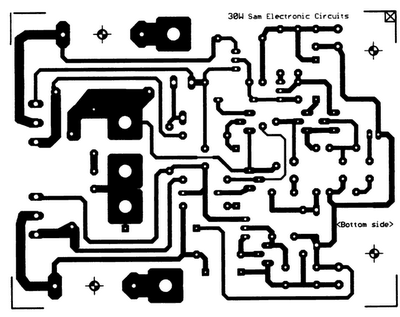
30 Watt audio amplifier PCB

30 Watt audio amplifier PCB


New 4 Channel Portable Audio Mixer

The target of this project was the design of a small portable mixer supplied by a 9V PP3 battery, keeping high quality performance. The mixer is formed assembling three main modules that can be varied in number and/or disposition to suit everyone needs. The three main modules are:

Input Amplifier Module: a low noise circuit equipped with a variable voltage-gain (10 - 100) preset, primarily intended as high quality microphone input, also suitable for low-level line input.

Tone Control Module: a three-band (Bass, Middle, Treble) tone control circuit providing unity-gain when its controls are set to flat frequency response. It can be inserted after one or more Input Amplifier Modules and/or after the Main Mixer Amplifiers.

Main Mixer Amplifier Module: a stereo circuit incorporating two virtual-earth mixers and showing the connection of one Main Fader and one Pan-Pot.

The image below shows a Block diagram of the entire mixer featuring four Input Amplifier Modules followed by four in-out switchable Tone Control Modules, one stereo Line input, four mono Main Faders, one stereo dual-ganged Main Fader, four Pan-Pots, a stereo Main Mixer Amplifier Module and two further Tone Control Modules switchable in and out for each channel, inserted before the main Left and Right outputs.

Obviously this layout can be rearranged at everyone wish. An astonishing feature of this design lies in the fact that a complete stereo mixer as shown below in the Block diagram draws less than 6mA current!

Block diagram:

4 channel input mixer

Input Amplifier Module
Circuit Diagram:

Parts:

R1 = 22K - 1/4W Resistor
R2 = 22K - 1/4W Resistor
R3 = 47K - 1/4W Resistor
R4 = 47K - 1/4W Resistor
R5 = 47K - 1/4W Resistor
R6 = 4K7 - 1/4W Resistor
R7 = 22K - 1/4W Resistor
R8 = 220R - 1/4W Resistor
R9 = 2K - 1/2W Trimmer Cermet (See Notes)
R10 = 470K - 1/4W Resistor
R11 = 560R - 1/4W Resistor
R12 = 100K - 1/4W Resistor
R13 = 220R - 1/4W Resistor

C1 = 470nF - 63V Polyester Capacitor
C2 = 100µF - 25V Electrolytic Capacitor
C3 = 2µ2 - 63V Electrolytic Capacitor
C4 = 2µ2 - 63V Electrolytic Capacitor
C5 = 2µ2 - 63V Electrolytic Capacitor
C6 = 47pF - 63V Ceramic Capacitor
C7 = 4µ7 - 63V Electrolytic Capacitor
C8 = 100µF - 25V Electrolytic Capacitor
Q1 = BC560C - 45V 100mA Low noise High gain PNP Transistor
Q2 = BC550C - 45V 100mA Low noise High gain NPN Transistor
IC1 = TL061 - Low current BIFET Op-Amp

Circuit Description:

The basic arrangement of this circuit is derived from the old Quad magnetic pick-up cartridge module. The circuit was rearranged to cope with microphone input and a single-rail low voltage supply. This low-noise, fully symmetrical, two-transistor head amplifier layout, allows the use of a normal FET input Op-Amp as the second gain stage, even for very sensitive microphone inputs. The voltage-gain of this amplifier can be varied by means of R9 from 10 to 100, i.e. 20 to 40dB.

Notes:
  • R9 can be a trimmer, a linear potentiometer or a fixed-value resistor at will.
  • When voltage-gain is set to 10, the amplifier can cope with 800mV peak-to-peak maximum Line levels.
  • Current drawing for one Input Amplifier Module is 600µA.
  • Frequency response is 20Hz to 20KHz - 0.5dB.
  • Total Harmonic Distortion measured with voltage-gain set to 100: 2V RMS output = <0.02%>
  • Total Harmonic Distortion measured with voltage-gain set to 10 & 33: 2V RMS output = <0.02%>
  • THD is much lower @ 1V RMS output.
  • Maximum undistorted output voltage: 2.8V RMS.

DC 2 Audio Amplifier

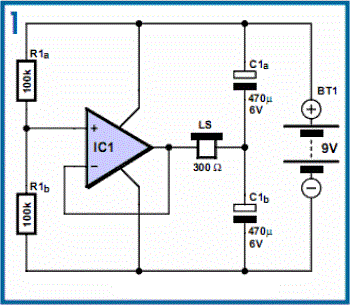
DC- 2 Audio Amplifier Circuit Diagram. Modelss for audio amplifiers with DC coupling to the load are not often encountered these days, even though they offer definite advantages. One advantage is that there is no need for the complication of a second (symmetric) power supply; another is good frequency and phase response. Also, no special electrolytic capacitors are needed for voltage stabilisation, and switch-on ‘thump’ is much reduced. To try to rescue this class of circuit from obscurity the author has designed a headphone amplifier working along the lines illustrated in Figure 1.
.
Circuit diagram

DC- 2 Audio Amplifier
DC-Coupled Audio Amplifier Circuit Diagram

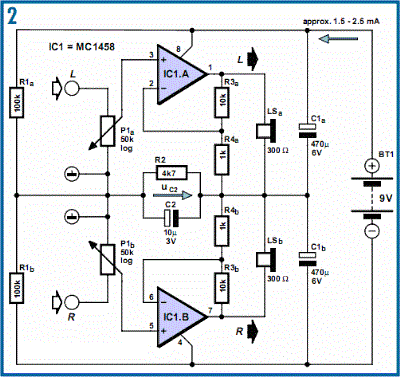
It consists of a voltage divider, a voltage follower and the loudspeaker in the headphones, whose other side is connected to the junction of two electrolytic capacitors, providing the virtual earth. The potential at this point is, of course, half the supply voltage. All we need to do now is suitably couple in the audio signal to be amplified. Figure 2 shows a practical realisation of this idea in the form of a stereo headphone amplifier. The amplifier itself consists of IC1 and P1, R3 and R4 (giving a gain of 11).
.
Circuit diagram:


DC- 2 Audio Amplifier 1
DC Coupled Audio Amplifier Circuit Diagram

This part of the circuit demands no further explanation, and the same goes for the voltage divider mentioned above, formed by R1a and R1b. The signal is coupled in via the potentiometers. C2 and R2 have a special purpose: C2 connects the bottom end of the potentiometers (ground for the input signal) to the virtual earth. However, this capacitor creates a feedback path which can lead to oscillation of the amplifier under some circumstances. R2 damps this tendency to oscillate.

It is possible to calculate suitable values for these components, but it is better to determine them by experiment. C2 must be sufficiently large that stray electric fields do not cause unacceptable hum at the output. R2 must be sufficiently large that the voltage at the amplifier’s virtual earth stabilises quickly enough after switch-on. The polarity of the electrolytic is unimportant as no significant voltage appears across the network. It is possible to try the circuit out with the C2/R2 network shorted and observe the behaviour of the circuit at switch-on using an oscilloscope. Depending on the degree of asymmetry in the circuit, the voltage at the virtual earth point can take a considerable time to stabilise.

Precision Audio Milli volt meter Circuits Diagram

This electronic circuit is audio milivolt meter. It measures 10mV to 50Volt RMS in eight ranges.

Precision Audio Millivoltmeter Circuits Diagram

Precision Audio Millivoltmeter Circuits Diagram
 
 Notes:
  • Connect J2 and J3 to an Avo-meter set to 50µA range:
  • Switching SW2 the four input ranges will be multiplied by 5
  • Total fsd ranges are: 10mV, 50mV, 100mV, 500mV, 1V, 5V, 10V, 50V
  • Set R11 to read 1V in the 1V range, with a sine wave input of 1V @ 1KHz
  • Compare the reading with that of another known precision Millivoltmeter or with an oscilloscope.
  • The oscilloscope reading must be a sinewave of 2.828V peak to peak amplitude
  • Frequency response is flat in the 20Hz-20KHz range
  • If you have difficulties in finding resistor values for R1, R2, R3 & R4, you can use the following trick:
    R1 = 10M + 1M in parallel
    R2 = 1M + 100K in parallel
    R3 = 100K + 10K in parallel
    R4 = 1K2 + 6K8 in parallel
    All resistors 1/4W 1% tolerance 

Parts:

R1_____909K    1/2W 1% Metal Oxide Resistor
R2______90K9   1/2W 1% Metal Oxide Resistor
R3_______9K09  1/2W 1% Metal Oxide Resistor
R4_______1K01  1/2W 1% Metal Oxide Resistor
R5_____100K    1/4W Resistor
R6_______2M2   1/4W Resistor
R7______82K    1/4W Resistor
R8______12K    1/4W Resistor
R9_______1K2   1/4W Resistor
R10______3K3   1/4W Resistor
R11____200R    1/2W Trimmer Cermet
 
C1_____330nF   63V Polyester Capacitor
C2,C3__100µF   25V Electrolytic Capacitor
C4_____220µF   25V Electrolytic Capacitor
C5______33pF   63V Polystyrene Capacitor
C6_______2µ2   63V Electrolytic Capacitor
 
D1-D4___1N4148 75V 150mA Diodes
 
IC1_____CA3140 Op-amp
IC2_____CA3130 Op-amp
 
SW1_____2 poles 5 ways rotary switch
SW2_____SPDT switch
 
J1______RCA audio input socket
J2,J3___4mm. output sockets
 
B1______9V PP3 Battery
 
Clip for PP3 Battery