Showing posts with label power. Show all posts

Thursday, November 20, 2014

65W Power Amplifier Circuits with HEXFET

65W65W Power Amplifier Circuits with HEXFET

A average ability amplifier that is characterized by a lot of acceptable complete quality, but accompanying is actual simple in the construction. Him uses, abundant time in my alive loudspeakers. In his achievement date abide the actual acceptable FET transistors, technology HEXFET, transistor which are controlled by voltage and no by accepted as the classically bipolar transistors. The ambit has balanced designing, absolute appropriately the harmonic baloney problem.

All the transistors that are acclimated in the ambit are simple and they abide in big clearings in the market. The pairs of cogwheel amplifiers Q1-2 and Q3-4 should be akin amid them and abreast the one in the other. Appropriately you can buy abundant transistors of types BC550C and BC560C, and with a multimeter you bout amid them creating pairs with aforementioned characteristics, ensuring appropriately compatible behavior in the temperature changes etc. Networks RC from the R7/C3 and R12/C4 abatement the bandwidth of cogwheel amplifiers and ability amplifier in the 6.5MHZ. Resistors R8-9-10-11 action as bounded acknowledgment in the cogwheel amplifiers convalescent the linearity. The cogwheel amplifiers are supplied with connected accepted from him accepted sources Q5 and Q6. The bent of accepted sources becomes from the aggregate of diodes LED D1, D2 and R20.

This becomes because the aggregate transistor/LED ensures big thermic stability, for this acumen should they are in actual abreast ambit [1]. With the TR1 trimmer we adapt the bent accepted of achievement ability stage. For this acumen Q8 should acquisition itself on the heatsink so that it ensures thermic adherence in the bias, so that it does not change with the temperature changes. The resistors R32-33 appearance a bounded acknowledgment bronchus in the achievement stage, because this functions as voltage amplifier.

With the TR1, R3-4, C14 we adapt the amplifier achievement DC account voltage, abreast in the zero. The transistors Q8-10-11-12-13, [Fig.1] should are placed on heatsink, abacus amid the transistors and the heatsink of acceptable affection leaves mica and ointment. Inductor L1 is constituted by 6 coils of cloistral cupreous wire of bore 1.5mm, with centralized inductor bore of 16mm
1 3V DC to 12 2V DC Regulator Power Supply

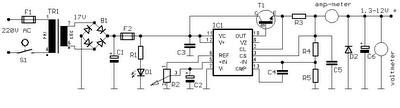
Power supply circuit to generate output below were variations between 1.3V DC to 12.2V DC with 1A current.
In addition, the power supply circuit is also equipped with over-current protection or shield against belebih flow. Power supply circuit is very simple, but the quality is quite good, made her basiskan regulator IC LM723 is a pretty legendary.


1.3V


Description:

R2 to set the output voltage. The maximum current is determined by R3, over-current protection circuit inside the LM723 to detect the voltage on R3, if it reaches 0.65 V, the voltage output will be off her. So the current through R3 can not exceed 0.65 / R3 although output short-circuit in his.

C3 and C4 are ceramic capacitors, as much as possible directly soldered to the PCB, this is because the LM723 is prone to oscillation that is not cool.

LM723 works with 9.5V input voltage to 40 V DC and the LM723 can generate its own current of 150mA when the output voltage is not more than 6-7V under input voltage.


Specifications:

Output (value estimated):

Vmin = (R4 + R5) / (R5 * 1.3)
Vmax = (7.15 / R5) * (R4 + R5)
Imax = 0.65/R3
Max. Power on R3: 0.42/R3


Min. DC Input Voltage (pin 12 to pin 7): Vmax + 5

Component List:

B1 40V/2.5A
C1 2200uF (3300uF even better)
C2 4.7uF
C3 100nF
C4 1NF
C5 330nF
C6 100uF
Green LED D1
D2 1N4003
F1 0.2A F
F2 2A M
IC1 LM723 (in a DIL14 plastic package)
R1 1k
R2 Pot. 5k
R3 0.56R/2W
R4 3.3k
R5 4.7k
S1 250V/1A
T1 2N3055 on a heatsink 5K / W
TR1 220V/17V/1.5

Sunday, November 16, 2014

Power supply using tube Z2C

Power supply using tube Z2C are designed specifically to provide power supply voltage to the EL-34 tube amplifier push-pull in the previous article. Power supply with Z2C tube to tube power amplifier is made with a tube rectifier Z2C.
Just as the power supply for power amplifier tubes previously, the power supply is also using a filter with 3 levels of electrolytic capacitors. The circuit power supply with tube rectifier can deliver Z2C +210 VDC output voltage.
Power
Z2C on the rectifier tube in power supply with tube above requires a supply voltage for the filaments taken from the other side of the transformer secondary. Z2C tube power supply with a power supply that is used as a substitute DAPT power supply for power amplifier tubes with a diode

Friday, November 14, 2014

STABILIZED POWER SUPPLY 3 30 V 2 5 A

This is a versatile power supply that will solve most of the supply problems arising in the everyday work of any electronics workshop. It covers a wide range of voltages being continuously variable from 30 V down to 3 V. The output current is 2.5 A maximum, more than enough for most applications. The circuit is completely stabilised even at the extremes of its output range and is fully protected against short-circuits and overloading.

Circuit Diagram


Working

The power supply is using a well known and quite popular VOLTAGE STABILIZER IC the LM 723. The IC can be adjusted for output voltages that vary continuously between 2 and 37 VDC and has a current rating of 150 mA which is of course too low for any serious use. In order to increase the current handling capacity of the circuit the output of the IC is used to drive a darlington pair formed by two power transistors the BD 135 and the 2N 3055. The use of the transistors to increase the maximum current output limits the range of output voltages somewhat and this is why the circuit has been designed to operate from 3 to 30 VDC. The resistor R5 that you see connected in series with the output of the supply is used for the protection of the circuit from overloading. If an excessively large current flows through R5, the voltage across it increases and any voltage greater than 0.3 V across it has as a result to cut the supply off, thus effectively protecting it from overloads. This protection feature is built in the LM 723 and the voltage drop across R5 is sensed by the IC itself between pins 2 and 3. At the same time the IC is continuously comparing the output voltage to its internal reference and if the difference exceeds the designer’s standards it corrects it automatically. This ensures great stability under different loads. The potentiometer P1 is used to adjust the out put voltage at the desired level. If the full range from 3 to 30 V is desired then you should use a mains transformer with a secondary winding having a rating of at least 24 V/3 A. If the maxi mum voltage output is not desired you can of course use a transformer with a lower secondary voltage output. (However, once rectified the voltage across the capacitor C2 should exceed by 4-5 volts the maximum output expected from the circuit.

Parts List

Resistors
R1 = 560R 1/4W
R2 = 1,2 K 1/4W
R3 = 3,9 K 1/4W
R4 = 15K 1/4W
R5 = 0,15R 5W 

Capacitors
C1 = 100nF
C2 = 2200uF 35-40V
C3 = 100 pF
C4 = 100uF/ 35V

Miscellaneous
D = B40 C3300/2200, 3A Rectifier Bridge
P1 = 10K Potentiometer
TR1 = BD 135
TR2 = 2N3055
IC = LM723

BD 135


2N3055


LM723

Wednesday, November 12, 2014

Usb Power Socket With Indicator

Today, almost all computers contain logic blocks for implementing a USB port. A USB port, in practice, is capable of delivering more than 100 mA of continuous current at 5V to the peripherals that are connected to the bus. So a USB port can be used, without any trouble, for powering 5V DC operated tiny electronic gadgets. Nowadays, many handheld devices (for instance, portable reading lamps) utilise this facility of the USB port to recharge their built-in battery pack with the help of an internal circuitry.

Circuit diagram:

Usb Power Socket Circuit Diagram

Usually 5V DC, 100mA current is required to satisfy the input power demand. Fig. 1 shows the circuit of a versatile USB power socket that safely converts the 12V battery voltage into stable 5V. This circuit makes it possible to power/recharge any USB power-operated device, using in-dash board cigar lighter socket of your car. The DC supply available from the cigar lighter socket is fed to an adjustable, three-pin regulator LM317L (IC1). Capacitor C1 buffers any disorder in the input supply.


Resistors R1 and R2 regulate the output of IC1 to steady 5V, which is available at the ‘A’ type female USB socket. Red LED1 indicates the output status and zener diode ZD1 acts as a protector against high voltage. Assemble the circuit on a general-purpose PCB and enclose in a slim plastic cabinet along with the indicator and USB socket. While wiring the USB outlet, ensure correct polarity of the supply. For interconnection between the cigar plug pin and the device, use a long coil cord as shown in Fig. 2. Pin configuration of LM317L is shown in Fig. 3. 

PC Power Saver

This circuit is designed to help minimise the  quiescent power consumption of PCs and  notebooks, using just our old friend the 555  timer and a relay as the main components. The  circuit itself dissipates around 0.5 W in operation (that is, when the connected PC is on);  when switched off (with the relay not energised) the total power draw is precisely zero. A prerequisite for the circuit is a PC or note book with a USB or PS/2 keyboard socket that  is powered only when the PC is on. The power saver can be used to switch PCs  or even whole multi-way extension leads. The unit can be built  into  an  ordinary  mains  adaptor (which must have an earth  pin!) as the photograph of the  author‘s prototype shows. The  PC is plugged in to the socket  at the output of the power saver  unit, and an extra connection  is made to the control input of  the unit from a PS/2 (keyboard or mouse) socket or USB port. Only  the 5 V supply line of the interface is used.
 
  
PC Power Saver Image

When button S1 on the power saver  is pressed the unit turns on, and the  monostable formed by the 555 timer is  triggered via the network composed by  R4 and C7. This drives relay RE1, whose contacts close. The connected PC is now tentatively powered up via the relay for a period  determined  by  P1  (approximately in the range from 5 s to 10 s). If, during this interval, the PC fails to indicate  that it is alive by supplying 5 V from its USB or  PS/2 connector (that is, if you do not switch  it on), the monostable period will expire, the  relay will drop out and any connected device  will be powered down. No further current will  be drawn from the supply, and, of course, it  will not be possible to turn the PC on. When-ever you want to turn the PC on, you must  always press the button on the power saver  shortly beforehand. 

If, however, 5 V is delivered by the PC to the  input of optocoupler IC2 before the monostable times out (which will be the case if the  PC is switched on during that period), the  transistor in the optocoupler will conduct  and discharge capacitor C6. The monostable  will now remain triggered and the relay will  remain energised until the PC is switched off  and power disappears from its USB or PS/2  interface. Then, after the monostable time  period expires, the relay will drop out and the  power saver will disconnect itself from the mains. There is no need to switch anything  else off: just shut down the system and the  power saver will take care of the rest.
 
Circuit diagram :
PC Power Saver Circuit Diagram
 
It is also  possible to leave the machine as it updates its  software, and the power saver will do its job  shortly after the machine shuts down. Power for the unit itself is obtained using a  simple supply circuit based around a miniature transformer. Alternatively, a 12 V mains  adaptor can be used, as long as a relay with a  12 V coil voltage is used for RE1. In his proto-type the author used a relay with a 24 V coil  connected as shown directly to the positive  side of reservoir capacitor C2, the 555 being  powered from 12 V regulated from that sup-ply using R1 and D1. A fixed resistor can of  course be used in place of P1 if desired. If the  adjustment range of P1 is not sufficient (for  example if the PC powers up very slowly) the  monostable period can be increased by using  a larger capacitor at C6.  The relay must have at least two normally-open (or changeover) contacts rated at at  least 8 A. The contact in parallel with S1 is used to supply power to the device  itself, and the other contact carries  all the current for the connected  PC  or  for  the  ex tension  lead  to  which  the  PC  and  peripherals  are  connected. 

Pushbutton S1 must be rated for 230 VAC  (US: 120 VAC) operation: this is no place to  make economies. The coil current for the relay  flows through LED D5, which must therefore  be a 20 mA type. If a low-current LED is used,  a 120 Ω resistor can be connected in parallel with it to carry the remaining current.  The Fujitsu FTR-F1CL024R relay used in the  author’s prototype has a rated coil current of  16.7 mA. Optocoupler IC2 provides isolation between  the circuit and the PC, and is protected from  reverse polarity connection by diode D4. The power saver should be built into an insulated enclosure and great care should be  taken to ensure that there is proper isolation  between components and wires carrying the  mains voltage and the other parts of the circuit. In particular, the connection to the PC  and associated components (R6, C5, D4 and  IC2) should be carefully arranged with at least  a 6 mm gap between them and any part of  the circuit at mains potential.

Saturday, November 8, 2014

Low Ripple Regulated Power Supply

This circuit may be used where a high current is required with a low ripple voltage (such as in a high powered class AB amplifier when high quality reproduction is necessary ).
PARTS LIST
R12.2KΩ 1W
R256Ω 1W
R31oKΩ 1W
C11000µF 63V
C2100µF 50V
C3470µF 50V
D1, D2, D3, D46A Bridge Rectifier
D5500mA Zener Diode (see description)
Q12N3055
Q22N3054
Q1, Q2, and R2 may be regarded as a power darlington transistor. D5 and R1 provide a reference voltage at the base of Q1. D5 should be chosen thus:
D5=Vout-1.2
C2 can be chosen for the degree of smoothness as its value is effectively multiplied by the combined gains of Q1/Q2, if 100µF is chosen for C2, assuming minimum hef for Q1 and Q2,
C=100×15(Q1)×25(Q2)
=37000µF.

Wednesday, November 5, 2014

Reducing Relay Power Consumption

Relays are often used as electrically controlled switches. Unlike transistors, their switch contacts are electrically isolated from the control input. On the other hand, the power dissipation in a relay coil may be unattractive for battery-operated applications. Adding an analogue switch lowers the dissipation, allowing the relay to operate at a lower voltage. The circuit diagram shows the principle. Power consumed by the relay coil equals V2/RCOIL. The circuit lowers this dissipation (after actuation) by applying less than the normal operating voltage of 5 V. Note that the voltage required to turn a relay on (pickup voltage)is usually greater than that to keep it on (dropout voltage).

Circuit Diagram :
Reducing_Relay_Power_Consumption

In this respect the relay shown has specifications of 3.5 and 1.5 V respectively, yet the circuit allows it to operate from an intermediate supply voltage of 2.5 V. Table 1 compares the relay’s power dissipation with fixed operating voltages across it, and with the circuit shown here in place. The power savings are significant. When SW1 is closed, current flows through the relay coil, and C1 and C2 begin to charge. The relay remains inactive because the supply voltage is less than its pickup voltage. The RC time constants are such that C1 charges almost completely before the voltage across C2 reaches the logic threshold of the analogue switch inside the MAX4624 IC.

Table_Reducing_Relay_Power_Consumption_Circuit_Diagramq

When C2 reaches that threshold, the on-chip switch connects C1 in series with the 2.5 V supply and the relay coil. This action causes the relay to be turned on because its coil voltage is then raised to 5 V, i.e., twice the supply voltage. As C1 discharges through the coil, the coil voltage drops back to 2.5 V minus the drop across D1. However, the relay remains on because the resultant voltage is still above the dropout level (1.5 V). Component values for this circuit depend on the relay characteristics and the supply voltage. The value of R1, which protects the analogue switch from the initial current surge through C1, should be sufficiently small to allow C1 to charge rapidly, but large enough to prevent the surge current from exceeding the specified peak current for the analogue switch.

The switch’s peak current (U1) is 400 mA, and the peak surge current is IPEAK = (VIN – VD1) / R1 + RON) where RON is the on-resistance of the analogue switch (typically 1.2 Ω). The value of C1 will depend on the relay characteristics and on the difference between VIN and the pickup voltage. Relays that need more turn-on time requires larger values for C1. The values for R2 and C2 are selected to allow C1 to charge almost completely before C2’s voltage reaches the logic threshold of the analogue switch. In this case, the time constant R2C2 is about seven times C1(R1 + RON). Larger time constants increase the delay between switch closure and relay activation. The switches in the MAX4624 are described as ‘guaranteed break before make’. The opposite function, ‘make-before break’ is available from the MAX4625. The full datasheets of these interesting ICs may be found at http://pdfserv.maxim-ic.com/arpdf/MAX4624-MAX4625.pdf

Boomer Audio Power Amplifier Using LM4906

The well-known LM386 is an excellent choice for many designs requiring a small audio power amplifier (1-watt) in a single chip. However, the LM386 requires quite a few external parts including some electrolytic capacitors, which unfortunately add volume and cost to the circuit.

National Semiconductor recently introduced its Boomer® audio integrated circuits which were designed specifically to provide high quality audio while requiring a minimum amount of external components (in surface mount packaging only). The LM4906 is capable of delivering 1 watt of continuous average power to an 8-ohm load with less than 1% distortion (THD+N) from a +5 V power supply. The chip happily works with an external PSRR (Power Supply Rejection Ratio) bypass capacitor of just 1 µF minimum.

In addition, no output coupling capacitors or bootstrap capacitors are required which makes the LM4906 ideally suited for cellphone and other low voltage portable applications. The LM4906 features a low-power consumption shutdown mode (the part is enabled by pulling the SD pin high).

Additionally, an internal thermal shutdown protection mechanism is provided. The LM4906 also has an internal selectable gain of either 6 dB or 12 dB. A bridge amplifier design has a few distinct advantages over the single-ended configuration, as it provides differential drive to the load, thus doubling output swing for a specified supply voltage. Four times the output power is possible as compared to a single-ended amplifier under the same conditions (particularly when considering the low supply voltage of 5 to 6 volts).

Boomer Audio Power Amplifier Circuit Diagram:


When pushed for output power, the small SMD case has to be assisted in keeping a cool head. By adding copper foil, the thermal resistance of the application can be reduced from the free air value, resulting in higher PDMAX values without thermal shutdown protection circuitry being activated. Additional copper foil can be added to any of the leads connected to the LM4906. It is especially effective when connected to VDD, GND, and the output pins. A bridge configuration, such as the one used in LM4906, also creates a second advantage over single-ended amplifiers. Since the differential outputs, Vo1 and Vo2, are biased at half-supply, no net DC voltage exists across the load.

This eliminates the need for an output coupling capacitor which is required in a single supply, single-ended amplifier configuration. Large input capacitors are both expensive and space hungry for portable designs. Clearly, a certain sized capacitor is needed to couple in low frequencies without severe attenuation. But in many cases the speakers used in portable systems, whether internal or external, have little ability to reproduce signals below 100 Hz to 150 Hz. Thus, using a large input capacitor may not increase actual system performance. Also, by minimizing the capacitor size based on necessary low frequency response, turn-on pops can be minimized.


Saturday, November 1, 2014

TDA1519C 11W Stereo 22W Mono Power Amp Diagram Circuit

Integrated AF power amps have seen great improvements in recent years offering improved power and easier use. The TDA1519C from Philips contains two power amplifiers providing 11 W per channel stereo or 22 W mono when the two channels are connected in a bridge configuration. The special in-line SIL9P package outline allows the chip to be conveniently bolted to a suitable heatsink. The TDA1519CSP is the SMD version, in this case the heat sink is mounted over, and in contact with, the top surface of the chip.

11W11W Stereo Amplifier Circuit Diagram

The operating voltage of this device is from +6V to +17.5V. The two channels of the amplifier are different in that one channel, between pins 1 and 4, is a non-inverting amplifier, while the other between pins 9 and 6 is an inverting amplifier. It is therefore necessary in stereo operation, to wire the speakers so that one of them has its polarity reversed. Each amplifier has an input impedance of 60kΩ and a voltage gain of 40dB, i.e. 100 times. When both amplifier are used in a bridge configuration, the inputs are in parallel so that the input impedance will be 30kΩ.

22W22W Stereo Amplifier Circuit Diagram

A combined mute/standby function is provided on pin 8. In its simplest form this can be connected to the positive rail via a switch. When the switch is open the amplifier will be in standby mode and current consumption is less than 100µA. When the switch is closed, the amplifier will be operational. A circuit is also shown that uses the mute input to prevent the annoying switch-on plop heard when power amps are first switched on This is caused by the rush of current to charge capacitors C1 and C2.

standbyMute/Standby Switch Circuit Diagram

The circuit shown generates a ramp voltage, which is applied to pin 8. At switch on, as the voltage rises from 3.3 V to 6.4 V, the amplifier will switch out of standby mode and into mute mode allowing C1 and C2 to charge. Only when the ramp voltage on pin 8 reaches 8.5V will the amplifier switch into active mode. Protection built into the TDA1519C would seem to make it almost foolproof. The two outputs can be shorted to either of the supply rails and to each other. A thermal shutdown will prevent overloading and the power supply input is protected against accidental reversal of the supply leads up to 6V

Friday, October 31, 2014

BENCH POWER SUPPLY

This power supply can be built in less than an hour on a piece of copper-laminate. The board acts as a heat-sink and the other components can be mounted as shown in the photo, by cutting strips to suit their placement.


The components are connected with enamelled wire and the transistor is bolted to the board to keep it cool.

The Bench Power Supply was designed to use old "C," "D" and lantern batteries, thats why there are no diodes or electrolytics. Collect all your old batteries and cells and connect them together to get at least 12v -14v.

The output of this power supply is regulated by a 10v zener made up of the characteristic zener voltage of 8.2v between the base-emitter leads of a BC547 transistor (in reverse bias) and approx 1.7v across a red LED. The circuit will deliver 0v - 9v at 500mA (depending on the life left in the cells your are using). The 10k pot adjusts the output voltage and the LED indicates the circuit is ON. Its a very good circuit to get the last of the energy from old cells.
 
source : http://www.talkingelectronics.com.au/projects/200TrCcts/200TrCcts.html

Thursday, October 30, 2014

1500 W Cobra Power Inverter 12VDC to 120VAC

1500Power Inverter manufactured by Cobra, capable converting input battery 12VDC to become 120VAC with power loads (output) up to 1500W.

This inverter gives household power on the go. It converts battery power to 120 V AC household power, permitting you to power up office equipment and household appliances from your vehicle. This unit is ideal for such appliances as microwave ovens (1000 watts or much less), coffeemakers, laptops, TVs, video game consoles, CD and DVD players, cell phone chargers, and far more.

How The Cobra Power Inverter Works
The Cobra power inverter is an electronic item that has been created and built to take low-voltage DC (Direct Current) power from your automobile or other low-voltage power supplies and convert it to standard 115 volt AC (Alternating Current) power like the current youve inside your residence. This conversion process thereby allows you to make use of numerous of your household appliances and electronic goods in automobiles, RVs, boats, tractors, trucks, and practically anywhere else.

Cobra 1500 Watt Output Waveform
Some quite sensitive electronic equipment could not operate satisfactorily on "square wave" or "modified sine wave" power. The output waveform of the Cobra Inverter is actually a "square wave" or "modified sine wave." It truly is a stepped waveform created to have characteristics similar to the sine wave shape of utility power. A waveform of this nature is suitable for most AC loads, including linear and switching power suppliers used in electronic equipment, transformers, and motors.

AC receptacles
With three ground AC receptacles, you can connect and power multiple devices at as soon as.

USB Output
The 5-Volt USB output permits charging and operation of modern portable devices, for example iPods, BlackBerrys, and cell phones.

Remote On/Off Switch Capable
An optional Remote On/Off Switch could be connected to the Remote Jack, allowing you to turn the Cobra power inverter on or off from a convenient location when the inverter is installed out of reach.

Safety Features
The CPI 1575 will notify you with a flashing meter and alarm sound when there is a power issue, and will shut down for protection in the following situations:

  • Current Overload Protection--If the inverter is overloaded, itll shut down to protect itself.
  • Short Circuit Protection--If the AC output of the inverter is short-circuited for 1 second or more, it is going to shut down to safeguard itself.
  • Low Voltage Protection--If the input voltage drops to 10.0V or much less, the inverter will shut down to protect itself.
  • High Voltage Protection--If the DC input voltage rises above 15.0V, the inverter will shut down to safeguard itself.
  • Over Temperature Protection--If the internal temperature rises to 40 degrees C (104 degrees F), the inverter will shut down to safeguard itself. 

LM377 Power amplifier schematic

Different places and use also requires a different power amplifier as well. For this time i gave a circuit schematic power amplifier based on LM377 ic that has similarities with the LM378 and LM1877. Power is smoothly small ouput is 2 X 2.5 Watt and the impedance 4 ohms. Use of this amplifier suitable for portable radio tuner that can be taken every where.
Component description :

Resistor
R1___________________2K
R2___________________2K
R3___________________1M
R4___________________1M

Capacitor
C1___________________4.7uF 50V
C2___________________4.7uF 50V
C3___________________100n
C4___________________100n
C5___________________470uF 50V
C6___________________470uF 50V

IC
IC1__________________LM377 , LM378 , LM1877

High End Power Amplifier Wiring Circuit

As the causes of the heat sink mounting surface to approximately 6 mm from the edge of the circle are fixed, assuming that the amplifier circuits mounted directly on the rails. This means that the leads of the transistors must be folded twice, so they are positioned properly, without a permanent mechanical stress in transistors. For high output transistors, the first corner a little closer to the plastic packaging than expected (in the wide part), otherwise the son of the rails or not to strike. Another possibility, which has the disadvantage that it weakens the structure, it is to grind enough metal in appropriate locations, to provide sufficient clearance. We have consciously rejected that option.

High-End

Once you have taken on these details and transistors can be easily placed on the free flat heatsink with her son through the holes in the circuit you can use the locations of the holes on the back mark of the radiators. Of course you must do so before the transistors are soldered to the track but is according to the holes for the final determination of the amplification circuits made in the base plate. Once the output transistors and their driver were mounted on the heat sink and soldered to the boards, the bottom plate can be removed easily.

Be careful not too much force on the terminals of the transistors, if the plates are exposed in this way.
Power transistors T14 and T15 must be mounted on heatsink bs with insulators (mica discs), while the other three transistors (Til, T12 and T13) can be screwed directly onto the heat sink. Make sure you use thermal paste to all the transistors.

After all the holes for the remaining circuits, transformers, switches and lights (front) and the ventilation slots in the chassis, you can screw up everything and you install the wiring.

Use well-designed audio cable connected to the input of the amplifier boards on the terminals in the vicinity of the inputs on the board overdrive display. With the two ground terminals to the input jacks for connecting the housing to the grounds of the two channels. This will avoid creating loops. The inputs to the outputs of the amplifier are in the middle of the board control overdrive removed. The best way to connect, to use thin, flexible cable, to connect the output jacks.

Wednesday, October 29, 2014

Transformerless 5 Volt DC Power Supply

An increasing number of appliances draw a very small current from the power supply. If you need to design a mains-powered device, you could generally choose between a linear and a switch-mode power supply. However, what if the appliance’s total power consumption is very small? Transformer-based power supplies are bulky, while the switchers are generally made to provide greater current output, with a significant increase in complexity, problems involving PCB layout and, inherently, reduced reliability.

Is it possible to create a simple, minimum part-count mains (230 VAC primary) power supply, without transformers or coils, capable of delivering about 100mA at, say, 5 V? A general approach could be to employ a highly inefficient stabilizer that would rectify AC and, utilizing a zener diode to provide a 5.1 V output, dissipate all the excess from 5.1 V to (230×√2) volts in a resistor. Even if the load would require only about 10mA, the loss would be approximately 3 watts, so a significant heat dissipation would occur even for such a small power consumption.


 At 100mA, the useless dissipation would go over 30 W, making this scheme completely unacceptable. Power conversion efficiency is not a major consideration here; instead, the basic problem is how to reduce heavy dissipation and protect the components from burning out. The circuit shown here is one of the simplest ways to achieve the above goals in practice. A JVR varistor is used for over-voltage/surge protection. Voltage divider R1-R2 follows the rectified 230 V and, when it is high enough, T1 turns on and T3 cannot conduct.

When the rectified voltage drops, T1 turns off and T3 starts to conduct current into the reservoir capacitor C1. The interception point (the moment when T1 turns off) is set by P1 (usually set to about 3k3), which controls the total output current capacity of the power supply: reducing P1 makes T1 react later, stopping T3 later, so more current is supplied, but with increased heat dissipation. Components T2, R3 and C2 form a typical ‘soft start’ circuit to reduce current spikes — this is necessary in order to limit C1’s charging current when the power supply is initially turned on. At a given setting of P1, the output current through R5 is constant.

Thus, load R4 takes as much current as it requires, while the rest goes through a zener diode, D5. Knowing the maximum current drawn by the load allows adjusting P1 to such a value as to provide a total current through R5 just 5 to 6mA over the maximum required by the load. In this way, unnecessary dissipation is much reduced, with zener stabilization function preserved. Zener diode D5 also protects C1 from over voltages, thus enabling te use of low-cost 16 V electrolytics. The current flow through R5 and D5, even when the load is disconnected, prevents T3’s gate-source voltage from rising too much and causing damage to device. In addition, T1 need not be a high-voltage transistor, but its current gain should exceed 120 (e.g. BC546B, or even BC547C can be used).

Tuesday, October 28, 2014

Mono Power Amplifier A1015 BD140 TIP2955

Typically audio amplifier stereo amplifier to a two amplifier. And if a mono amplifier is a single speaker. However this circuit command be present extended to the mono two loudspeaker.But not a equivalence or else serialization access.This makes it needless impedance of the speaker has altered.But will remain to utilize the spokeswoman as a replacement for of the resistance - Collection Peter (RC) of the transistor.The circuit can be alive prolonged to 2 loudspeaker itself.

Mono Power Amplifier - A1015, BD140 ,TIP2955 Circuit Diagram
What time raising the power supply circuit and the audio to input. the audio sign coupling to through the C1 and R1 to increase with the Q1.Which Q1 serves like the Regional Pre amp amplifier to power up to a one point.already conveyance it to Q2.Which Q2 is connected to emitter follower circuit.be active as a driver amplifier intimate section from the pre amp section provides added power to drive the Q3 perform. and Q3 motivation provide while a Regional Power amp amplifier output to the spokeswoman.The opinion of the audio intimate through the VR1 and R2 to enter the pin B of Q2.To control the stability of working instead of well brought-up.This circuit is an output of 40 milliwatts watts of distortion of the gesture rate is by the side of 0.1 percent.And frequency response from 15 Hz - 200 kHz.

Sunday, October 26, 2014

LM2876 40W audio power amplifier Diagram Circuit

Using the LM2876 high-performance audio power amplifier circuit can be designed a very simple high efficiency power audio amplifier electronic project capable of delivering 40W of continuous average power to an 8Ω load with 0.1% THD+N from 20Hz–20kHz.
The performance of the LM2876 high-performance audio power amplifier, utilizing its Self Peak Instantaneous Temperature (°Ke) (SPiKe™) protection circuitry, puts it in a class above discrete and hybrid amplifiers by providing an inherently, dynamically protected Safe Operating Area (SOA). SPiKe protection means that these parts are completely safeguarded at the output against overvoltage, undervoltage, overloads, including shorts to the supplies, thermal runaway, and instantaneous temperature peaks.
The LM2876 maintains an excellent signal-to-noise ratio of greater than 95dB (min) with a typical low noise floor of 2.0μV.

As you can see in the circuit diagram , this 40W high-performance audio power amplifier electronic project require few external electronic parts and require few knowledge .
The muting function of the LM2876 allows the user to mute the music going into the amplifier by drawing less than 0.5 mA out of pin 8 of the device.
Upon system power-up the under-voltage protection circuitry allows the power supplies and their corresponding caps to come up close to their full values before turning on the LM2876 such that no DC output spikes occur.
The LM2876 contains overvoltage protection circuitry that limits the output current to approximately 4Apeak while also providing voltage clamping, though not through internal clamping diodes.
The LM2876 has a sophisticated thermal protection scheme to prevent long-term thermal stress to the device. When the temperature on the die reaches 165°C, the LM2876 shuts down. It starts operating again when the die temperature drops to about 155°C
The LM2876 high-performance audio power amplifier circuit operates over a wide input voltage range , from 20 up to 70 volts , but typically a dual 30 volt power supply ( or a single 60 volt in this case ) will be work fine

Saturday, October 25, 2014

How to build Power Flip Flop Using A Triac

Modern electronics is indispensable for every large model railroad system, and it provides a solution to almost every problem. Although ready-made products are exorbitantly expensive, clever electronics hobbyists try to use a minimum number of components to achieve optimum results together with low costs. This approach can be demonstrated using the rather unusual semiconductor power flip-flop described here. A flip-flop is a toggling circuit with two stable switching states (bistable multivibrator). It maintains its output state even in the absence of an input pulse.

Flip-flops can easily be implemented using triacs if no DC voltage is available. Triacs are also so inexpensive that they are often used by model railway builders as semiconductor power switches. The decisive advantage of triacs is that they are bi-directional, which means they can be triggered during both the positive and the negative half-cycle by applying an AC voltage to the gate electrode (G). The polarity of the trigger voltage is thus irrelevant. Triggering with a DC current is also possible. Figure 1 shows the circuit diagram of such a power flop-flop. A permanent magnet is fitted to the model train, and when it travels from left to right, the magnet switches the flip-flop on and off via reed switches S1 and S2.

Circuit diagram:

In order for this to work in both directions of travel, another pair of reed switches (S3 and S4) is connected in parallel with S1 and S2. Briefly closing S1 or S3 triggers the triac. The RC network C1/R2, which acts as a phase shifter, maintains the trigger current. The current through R2, C1 and the gate electrode (G) reaches its maximum value when the voltage across the load passes through zero. This causes the triac to be triggered anew for each half-cycle, even though no pulse is present at the gate. It remains triggered until S2 or S4 is closed, which causes it to return to the blocking state.The load can be incandescent lamps in the station area (platform lighting) or a

solenoid-operated device, such as a crossing gate. The LED connected across the output (with a rectifier diode) indicates the state of the flip-flop. The circuit shown here is designed for use in a model railway system, but there is no reason why it could not be used for other applications. The reed switches can also be replaced by normal pushbutton switches. For the commonly used TIC206D triac, which has a maximum current rating of 4 A, no heat sink is necessary in this application unless a load current exceeding 1 A must be supplied continuously or for an extended period of time. If the switch-on or switch-off pulse proves to be inadequate, the value of electrolytic capacitor C1 must be increased slightly.
Author: R. Edlinger - Copyright: Elektor July-August 2004

Simple Automatic Switch For Audio Power Amplifier


Simple Automatic Switch For Audio Power Amplifier Circuit of an automatic switch for audio power amplifier stage is presented here. The circuit uses stereo preamplifier output to detect the presence of audio to switch the audio power amplifier on only when audio is present. The circuit thus helps curtail power wastage. IC1 is used as an inverting adder. The input signals from left and right channels are combined to form a common signal for IC2, which is used as an open loop comparator. IC3 (NE556) is a dual timer. Its second section, i.e., IC3(b), is configured as monostable multivibrator. Output of IC3(b) is used to switch the power amplifier on or off through a Darlington pair formed by transistors T1 and T2. IC3(a) is used to trigger the monostable multivibrator whenever an input signal is sensed.

Circuit diagram:
Automatic Switch For Audio Power Amplifier-Circuit-Diagram
Automatic Switch For Audio Power Amplifier Circuit Diagram

Under ‘no signal’ condition, pin 3 of IC2 is negative with respect to its pin 2. Hence the output of IC2 is low and as a result output of IC3(a) is high. Since there is no trigger at pin 8 of IC3(b), the output of IC3(b) will be low and the amplifier will be off. When an input singal is applied to IC1, IC2 converts the inverted sum of the input signals into a rectangular waveform by comparing it with a constant voltage which can be controlled by varying potentiometer VR1. When the output of IC2 is high, output pin 5 of IC3 goes low, thus triggering the monostable multivibrator. As soon as the audio input to IC1 stops, pin 5 of IC3 goes high and pin 1 of IC3 discharges through capacitor C3, thus resetting the monostable multivibrator. 

Hence, as long as input signals are applied, the amplifier remains ‘on.’ When the input signals are removed, i.e., when signal level is zero, the amplifier switches off after the mono flip-flop delay period determined by the values of resistor R8 and capacitor C3. If no input signals are sensed within this time, the amplifier turns off—else it remains on. Power supply for the circuit can be obtained from the power supply of the amplifier. Hence, the circuit can be permanently fitted in the amplifier box itself. The main switch of the amplifier should be always kept on. Resistors R1 and R2 are used to divide single voltage supply into two equal parts.

Capacitors C1 and C2 are used as regulators and also as an AC bypass for input signals. Diode D1 is used so that loading fluctuations in power amplifier do not affect circuit regulation. Transisitor T2 acts as a high voltage switch which may be replaced by any other high voltage switching transistor satisfying amplifier current requirements. Value of resistor R10 should be modified for large current requirement. The LED glows when the amplifier is on. The circuit is very useful and relieves one from putting the amplifier on and off every time one plays a cassette or radio etc. 

Source : EFY

Simple Automatic Load Sensing Power Switch

This circuit will automatically switch on several mains-powered "slave" loads when a "master" load is turned on. For example, it will switch on the amplifier and CD player in a stereo system when the receiver is turned on. It works by sensing the current draw of the "master" device through a low value high wattage resistor using a comparator. The output of that comparator then switches on the "slave" relay. The circuit can be built into a power bar, extension cord or power center to provide a convenient set of "smart" outlets that switch on when the master appliance is powered (turn on the computer monitor and the computer, printer and other peripherals come on as well).

Parts


Part            


  Total Qty.


Description


C1, C3               2               10uF 35V Electrolytic Capacitor
C2     1               1uF 35V Electrolytic Capacitor
R1     1               0.1 Ohm 10W Resistor
R2     1               27K 1/2W Resistor
R3, R4     1               1K 1/4W Resistor
R5     1               470K 1/4W Resistor
R6     1               4.7K 1/2W Resistor
R7     1               10K 1/4W Resistor
D1, D2, D4     3               1N4004 Rectifier Diode
D3     1               1N4744 15V 1 Watt Zener Diode
U1     1               LM358N Dual Op Amp IC
Q1     1               2N3904 NPN Transistor
K1     1               Relay, 12VDC Coil, 120VAC 10A Contacts
S1     1               SPST Switch 120AVC, 10A
MISC     1               Board, Wire, Socket For U1, Case, Mains Plug, Socket
Notes
  • This circuit is designed for 120V operation. For 240V operation, resistors R2 and R6 will need to be changed.
  • A maximum of 5A can be used as the master unless the wattage of R1 is increased         S1 provides a manual bypass switch.
  • THis circuit is not isolated from the mains supply. Because of this, you must exercise extreme caution when working around the circuit if it is plugged in.