Showing posts with label Alarm. Show all posts

Tuesday, November 4, 2014

Long Range Cordless Burglar Alarm

This long-range cordless burglar alarm circuit makes use of a cordless telephone (CLT) unit with paging facility and a few low-cost discrete components. The circuit is so simple that even a novice can easily construct it without any difficulty. When the ‘page’ button on a CLT is pressed and held in that position, the handset starts beeping to indicate that somebody is calling. This function is used here to build the gadget. The system consists of three sub-assemblies:


1. Wireless beeper. The handset of the CLT.
2. Infrared transmitter. A number of IR transmitter circuits based on the well-known 555 chip have been published earlier in EFY. Just select one circuit with a modulating frequency of 36 to 38 kHz and assemble it on a veroboard. After that, enclose it in a proper cabinet. (EFY note. A typical IR transmitter circuit used during testing is shown in Fig. 1.)


3. Infrared receiver-cum-control unit. The circuit diagram of this unit is shown in Fig. 2. Front end of this block is Sharp’s GP1U561X integrated infrared re-ceiver module (or TK1836/ TSOP1836 from Temic/ Telefunken, etc). This mod-ule can demodulate 36kHz modulated IR beam to pro-duce an active-similar  ‘low’ output. You may also use any other module, provided it has an active-‘low’ output. The modulated IR beam from the transmitter is received by the receiver module and its output at pin 2 goes ‘low’. The rest of the circuit is in sleep mode as it does not get power for its operation. The SCR here plays the role of an electronic switch. 

When the infrared beam is interrupted, the output of the receiver module goes ‘high’ to apply a forward bias to the base of transistor T1. As a result, the gate of SCR gets sufficient forward bias to conduct (and latch). The astable multivibrator built around IC1 starts working to control the  ‘on’/‘off’ relay timings. Diode D1 prevents the relay from latching and diode D2 works as a free-wheeling diode.
Normally open (N/O) contacts of the relay are used to close the  ‘page’ button contacts until the circuit is reset by pressing push-to-off switch S1 (N/C type). One may replace switch S1 with a key-lock switch to avoid its unauthorised operation. The astable circuit helps the hand-set user to distinguish between a normal paging call and an intrusion warning alarm.


After construction, fix the transmitter and receiver modules at opposite sides in the door frame as shown in Fig. 3. Carefully open the CLT and solder two wires to the  ‘page’ button terminals with their free ends connected to the relay contacts (N/O). Now your cordless burglar alarm with a wireless monitoring range of about 500 meters (actual range is based on the CLT’s paging range) is ready to detect an intruder.
EFY note. The author has success-fully tested his prototype with the following CLT makes:
  • Panasonic KX-T 3611 BH (made in Japan)
  • Panaphone WT-3990 (made in China)
  • Citizen JRT-5400 (made in India)

Monday, October 27, 2014

Fuse Failure Alarm 2 LED

This circuit motivation let somebody see the performance of the equipment,otherwise Check the fuse arrived the circuit.The circuit is insignificant and the power supply voltage of all kinds. It parade with LED, 2-color in single. Which is cathode normal kind,the anode has two separate terminals. If the circuit is functioning accurately LED, it exposed in environmentally friendly colour.


The display is red, at what time the fuse voguish the circuit is damaged.The resistor R1 limits the current to stream through the LED is going on for 2 mA.This is a sufficient amount to do the LED light.If it lowers the R1 down, the LED light up. In the regular action of the circuit and The fuse is not damaged. The zener diode to prevent the green and red LED light up at once.Zener diode prevents the LED is sea green and red illumination at the same time. The high-pitched efficiency LED, whilst connected in the sphere of congruence. The red LED uses high-pressure, so with the intention of single green LED illumination up only. Diodes D3 and D4 command prevent perilous in support of the LED. While the semi cycle denial voltage of the alternating current voltage.However, if the DC supply voltage.I perform not include to application diode protection.

Saturday, October 25, 2014

How to build Personal alarm

Small, portable, anti-bag-snatching unit Also suitable for doors and windows control

Circuit diagram


Parts:

  • R1 330K 1/4W Resistor
  • R2 100R 1/4W Resistor
  • C1 10nF 63V Polyester or Ceramic Capacitor
  • C2 100µF 25V Electrolytic Capacitor
  • Q1 BC547 45V 100mA NPN Transistor
  • Q2 BC327 45V 800mA PNP Transistor
  • SW1 Reed Switch and small magnet (See Notes)
  • SPKR 8 Ohm Loudspeaker (See Notes)
  • B1 3V Battery (two A or AA cells wired in series etc.)

Device purpose:

This circuit, enclosed in a small plastic box, can be placed into a bag or handbag. A small magnet is placed close to the reed switch and connected to the hand or the clothes of the person carrying the bag by means of a tiny cord. If the bag is snatched abruptly, the magnet looses its contact with the reed switch, SW1 opens, the circuit starts oscillating and the loudspeaker emits a loud alarm sound. The device can be reverse connected, i.e. the box can be placed in a pocket and the cord connected to the bag. This device can be very useful in signalling the opening of a door or window: place the box on the frame and the magnet on the movable part in a way that magnet and reed switch are very close when the door or window is closed.

Circuit operation:

A complementary transistor-pair is wired as a high efficiency oscillator, directly driving a small loudspeaker. Low part-count and 3V battery supply enable a very compact construction.

Notes:

  • The loudspeaker can be any type, its dimensions are limited only by the box that will contain it.
  • An on-off switch is unnecessary because the stand-by current drawing is less than 20µA.
  • Current consumption when the alarm is sounding is about 100mA.
  • If the circuit is used as anti-bag-snatching, SW1 can be replaced by a 3.5mm mono Jack socket and the magnet by a 3.5mm. mono Jack plug with its internal leads shorted. The Jack plug will be connected with the tiny cord etc.
  • Do not supply this circuit with voltages exceeding 4.5V: it will not work and Q2 could be damaged. In any case a 3V supply is the best compromise.

5 Zone Alarm System

This is a complete alarm system with 5 independent zones suitable for a small office or home environment. It uses just 3 CMOS ICs and features a timed entry / exit zone, 4 immediate zones and a panic button. There are indicators for each zone a "system armed" indicator. The schematic is as follows:


5 zone alarm


Circuit Notes
Each zone uses a normally closed contact. These can be micro switches or standard alarm contacts (usually reed switches). Suitable switches can be bought from alarm shops and concealed in door frames, or window ledges.

Zone 1 is a timed zone which must be used as the entry and exit point of the building. Zones 2 - 5 are immediate zones, which will trigger the alarm with no delay. Some RF immunity is provided for long wiring runs by the input capacitors, C1-C5. C7 and R14 also form a transient suppressor. The key switch acts as the Set/Unset and Reset switch. For good security this should be the metal type with a key.

Operation
At switch on, C6 will charge via R11, this acts as the exit delay and is set to around 30 seconds. This can be altered by varying either C6 or R11. Once the timing period has elapsed, LED6 will light, meaning the system is armed. LED6 may be mounted externally (at the bell box for example) and provides visual indication that the system has set. Once set any contact that opens will trigger the alarm, including Zone 1. To prevent triggering the alarm on entry to the building, the concealed re-entry switch must be operated. This will discharge C6 and start the entry timer. The re-entry switch could be a concealed reed switch, located anywhere in a door frame, but invisible to the eye. The panic switch, when pressed, will trigger the alarm when set. Relay contacts RLA1 provide the latch, RLA2 operate the siren or buzzer.


Author : Andy Collinson

Build a Blocking Circuit with Alarm for Bicycle

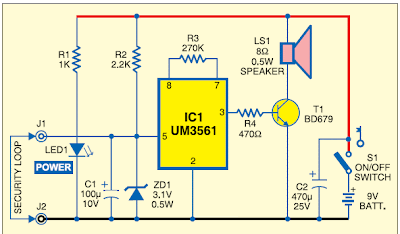
Here is an interesting circuit, it is used to make a kind of lock or locks for bicycles, it allows owners to implement a bicycle lock and electronic alarm with a low cost. The operation of the electronic lock is simple, it has a circuit that uses a tone generator IC UM3561, this IC generates a sound when your bike has the protection wire that surrounds the wheel broken.

 Blocking Circuit with Alarm for Bicycle Circuit Diagram

Blocking Circuit with Alarm for Bicycle


Click here to download complete project

Thursday, October 16, 2014

Auto Anti Hijack Alarm Circuit Diagram

This Auto Anti-Hijack Alarm Circuit Diagram was designed primarily for the situation where a hijacker forces the driver from the vehicle. If a door is opened while the ignition is switched on - the circuit will trip. After a few minutes delay - when the thief is at a safe distance - the Siren will sound.

Auto

Where it differs from the first two alarms - is in what happens next. Im obliged to Victor Montanez from the USA who suggested that the engine cut-out should not operate - until the vehicle comes to a stop. That way - the engine will not fail suddenly or unexpectedly. And the hijacker will retain control.

I havent been able to implement Victors excellent suggestion completely - because I couldnt think of a simple, reliable and universally applicable way of sensing when the vehicle has come to a stop.

Instead - I have postponed engine failure until the ignition is switched off. Once the thief turns off the ignition - the engine will not re-start. Clearly - there is no certainty as to when this will occur. But I think it will occur sooner rather than later. Because theres a strong possibility that the hijacker will turn off the ignition - in an attempt to silence the siren. 

 Auto Anti-Hijack Alarm Circuit Diagram

Auto


As well as acting as a Hijack Alarm - this circuit offers some added protection. Like the Enhanced Hijack Alarm - it incorporates Jeff Chias suggestion. That is - every time the ignition is switched on - the alarm will trip. So it will protect the vehicle whenever you leave it unattended with the ignition switched off - even overnight in your driveway.

Importance
Before fitting this or any other engine cut-out to your vehicle - carefully consider both the safety implications of its possible failure - and the legal consequences of installing a device that could cause an accident. If you decide to proceed - you will need to use the highest standards of materials and workmanship.

Notes
Youre going to trip this alarm unintentionally. When you do - the LED will light and the Buzzer will give a short beep. The length of the beep is determined by C4. Its purpose is to alert you to the need to push the reset button. When you push the button - the LED will switch-off. Its purpose is to reassure you that the alarm has in fact reset. 

If the reset button is not pressed then - about 3 minutes later - both the Siren and the Buzzer will sound continuously. The length of the delay is set by R8 & C5. For extra effect - fit a second siren inside the vehicle. With enough noise going on - you may feel that its unnecessary to fit the engine cut-out. In which case - you can leave out C7, D8, R12, R13, Ty1 & Ry2.

When the ignition is switched on - C3 & R4 are responsible for tripping the alarm. By taking pin 1 low momentarily - they simulate the opening of a door. If you dont want the alarm to trip every time you turn on the ignition - simply leave out C3 & R4. 

Because the voltage on C3 may be reversed - the capacitor needs to be non-polarized. But connecting two regular 22uF capacitors back to back as shown - will work just as well. Because non-polarized capacitors are not widely available - the prototype was built using two polarized capacitors.

To reset the circuit you must - EITHER turn off the ignition - OR close all of the doors - before you press the reset button. While BOTH the ignition is on - AND a door remains open - the circuit will NOT reset.

The reset button carries virtually no current - so any small normally-open switch will do. Eric Vandel from Canada suggests using a reed-switch hidden behind (say) the dash - and operated by a magnet. I think this is an excellent idea. As Eric said in his email: - "... that should keep any thief guessing for a while."

Veroboard Layout

Veroboard
 
How you prevent the engine from starting is up to you. It should happen when Ry2 de-energizes. The contacts of Ry2 are too small to do the job themselves. So use them to switch the coil of a larger relay. Remember that the relay must be suitable for the current its required to carry. Choose one specifically designed for automobiles - it will be protected against the elements - and will give the best long-term reliability. You dont want it to let you down on a cold wet night - or worse still - in fast moving traffic!!! Remember also that you must fit a 1N4001 diode across YOUR relays coil - to prevent damage to the Cmos IC
YOUR relay should drop-out when Ry2 de-energizes. Wire YOUR relay so that when it drops-out the engine will not start. Because turning-off the ignition will cause both Ry2 and YOUR relay to de-energize - the standby current will be low - and the engine will be disabled while the vehicle is parked.
The circuit board must be protected from the elements. Dampness or condensation will cause malfunction. Fit a 1-amp in-line fuse AS CLOSE AS POSSIBLE to your power source. This is VERY IMPORTANT. The fuse is there to protect the wiring - not the components on the circuit board. Please note that I am UNABLE to help any further with either the choice of a suitable relay - or with advice on installation.
Both the Siren and the Buzzer will go on sounding until the alarm is reset. The circuit is designed to use an electronic Siren drawing up to about 500mA. Its not usually a good idea to use the vehicles own Horn because it can be easily located and disconnected. However, if you choose to use the Horn, remember that Ry1 is too small to carry the necessary current. Connect the coil of a suitably rated relay to the "Siren" output. This can then be used to sound the Horn.


Thursday, September 25, 2014

Three Phase Sequence Change Warning Indicator Alarm Circuit

In electric motors, phase sequence in 3 phase configuration is very important. Change in phase sequence  may cause trouble in machines.
Here is 1 a circuit which indicates the change in 1 phase sequence by a beeper or an LED. Transistors Tl, T2 and T3 are used. to square the 3 phase waveforms. The resistor value should be such that the transistor gets fully saturated when the base voltage becomes 10V. During negative cycle, the diode at the base keeps the reverse voltage below 0.6V. It is assumed that if the phase sequence is correct, the red phase lags the yellow-phase by l20° and the green-phase lags the red-phase by 120°. Any change from this sequence produces a beeping sound.


Transistor T4 is not only used for phase inversion but also to decrement the slope of the rising and falling edge (i.e to decrement the rise time of g the square wave). Output of this transistor is fed to the clock input of t the flip(IC 7476). Thus, during every cycle the phase sequence is checked. For the clock, squared waveform of the yellow—phase is used. Other phases are inverted during squaring operation. So at the falling edge, transistor T3 is cut-off and T2 is in saturation: Collector of T2 is connected to the input J and`K of lC1b. So at the clock edge we get low at both the inputs. Collector of T3 is connected to K input of ICla and J of IC1b resulting in high output at the clock pulse. At the rising edge of the clock we get J low and K high for ICla. So it gets reset  and gives high at Qi. Similarly, when V the J and K inputs of IC1b are high the Y flip-flop is set. The Q output of IC1ai and Q output of IC lb are O Red and fed Ig at the base of T5 in order to switch on the alarm. In place of the alarm, an LED can also be used as an indicator. As long as the phase sequence is correct, both Q of ICla and Q of lClb are high and the transistor SK100 remains in off state.

Whenever thc phase sequence changes, both the outputs become low and turn on transistor T5. The beeper circuit comprises of a low frequency oscillator and a high frequency oscillator. The low frequency oscillator, which oscillates at l0 Hz, makes the high frequency oscillator enable and disable. The high frequency oscillator produces 3kHz output and a beeping sound in the speaker. lf a relay driven circuit is used, the system can be turned off when the phase change occurs.