Showing posts with label for. Show all posts

Wednesday, November 19, 2014

Light Switch for Lamps Controller

Light switch series with photo transistor above can be used to control garden lights, street lights, or night lamps automatic. Light switches can be made from several kinds of light sensors. The circuit of light switches are made using a photo transistor light sensors. The series of light switches or light control switch is very simple, because it is made with 1 piece of transistors, 1 piece of photo transistor, 1 relay, 1 variable resistors and diodes.
The series of light switches can work on the voltage 6-12 VDC or DC voltage that judgments in accordance with the relay is used. To set the sensitivity of the exposure is set by VR1.  Light switch series with photo transistors can be used to control some lights in parallel with the power depends on the ability of the relay is used.

Circuit of  Light switch


Wednesday, October 29, 2014

Petrol Gas Switch For A Pajero Diagram Circuit

My current vehicle, a Pajero, was modified for dual fuel - ie, petrol and gas. However, its necessary to run the vehicle on petrol at regular intervals to stop the injectors from clogging up. This simple circuit allows the vehicle to be started using petrol and then automatically switches it to gas when the speed exceeds 45km/h and the brake pedal is pressed. Alternatively, the vehicle may be run on petrol simply by switching the existing petrol/gas switch to petrol. You can also start the vehicle on gas by pressing the brake pedal while starting the vehicle. The circuit is based on an LM324 dual op amp, with both op amps wired as comparators. It works like this: IC1a buffers the signal from the vehicles speed sensor and drives an output filter network (D1, a 560kO resistor and a 10µF capacitor) to produce a DC voltage thats proportional to the vehicles speed.

Circuit diagram:

This voltage is then applied to pin 5 of IC1b and compared with the voltage set by trimpot VR1. When pin 7 of IC1b goes high, transistor Q1 turns on. This also turns on transistor Q2 when the brake pedal is pressed (pressing the brake pedal applies +12V from the brake light circuit to Q2s emitter). And when Q2 turns on, relay 1 turns on and its contacts switch to the gas position. Trimpot VR1 must be adjusted so that IC1bs pin 7 output switches high when the desired trigger speed is reached (ie, 45km/h). In effect, the speed signal is ANDed with the brake light signal to turn on the relay. The vehicle has been running this circuit for several years now and is still running well, with no further injector cleans required.
Author: J. Malnar - Copyright: Silicon Chip Electronics

Saturday, October 25, 2014

Simple Automatic Switch For Audio Power Amplifier


Simple Automatic Switch For Audio Power Amplifier Circuit of an automatic switch for audio power amplifier stage is presented here. The circuit uses stereo preamplifier output to detect the presence of audio to switch the audio power amplifier on only when audio is present. The circuit thus helps curtail power wastage. IC1 is used as an inverting adder. The input signals from left and right channels are combined to form a common signal for IC2, which is used as an open loop comparator. IC3 (NE556) is a dual timer. Its second section, i.e., IC3(b), is configured as monostable multivibrator. Output of IC3(b) is used to switch the power amplifier on or off through a Darlington pair formed by transistors T1 and T2. IC3(a) is used to trigger the monostable multivibrator whenever an input signal is sensed.

Circuit diagram:
Automatic Switch For Audio Power Amplifier-Circuit-Diagram
Automatic Switch For Audio Power Amplifier Circuit Diagram

Under ‘no signal’ condition, pin 3 of IC2 is negative with respect to its pin 2. Hence the output of IC2 is low and as a result output of IC3(a) is high. Since there is no trigger at pin 8 of IC3(b), the output of IC3(b) will be low and the amplifier will be off. When an input singal is applied to IC1, IC2 converts the inverted sum of the input signals into a rectangular waveform by comparing it with a constant voltage which can be controlled by varying potentiometer VR1. When the output of IC2 is high, output pin 5 of IC3 goes low, thus triggering the monostable multivibrator. As soon as the audio input to IC1 stops, pin 5 of IC3 goes high and pin 1 of IC3 discharges through capacitor C3, thus resetting the monostable multivibrator. 

Hence, as long as input signals are applied, the amplifier remains ‘on.’ When the input signals are removed, i.e., when signal level is zero, the amplifier switches off after the mono flip-flop delay period determined by the values of resistor R8 and capacitor C3. If no input signals are sensed within this time, the amplifier turns off—else it remains on. Power supply for the circuit can be obtained from the power supply of the amplifier. Hence, the circuit can be permanently fitted in the amplifier box itself. The main switch of the amplifier should be always kept on. Resistors R1 and R2 are used to divide single voltage supply into two equal parts.

Capacitors C1 and C2 are used as regulators and also as an AC bypass for input signals. Diode D1 is used so that loading fluctuations in power amplifier do not affect circuit regulation. Transisitor T2 acts as a high voltage switch which may be replaced by any other high voltage switching transistor satisfying amplifier current requirements. Value of resistor R10 should be modified for large current requirement. The LED glows when the amplifier is on. The circuit is very useful and relieves one from putting the amplifier on and off every time one plays a cassette or radio etc. 

Source : EFY

Build a Blocking Circuit with Alarm for Bicycle

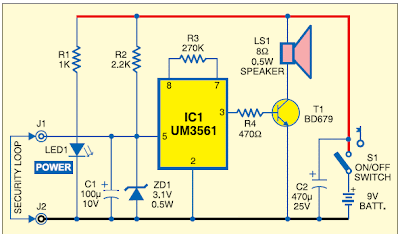
Here is an interesting circuit, it is used to make a kind of lock or locks for bicycles, it allows owners to implement a bicycle lock and electronic alarm with a low cost. The operation of the electronic lock is simple, it has a circuit that uses a tone generator IC UM3561, this IC generates a sound when your bike has the protection wire that surrounds the wheel broken.

 Blocking Circuit with Alarm for Bicycle Circuit Diagram

Blocking Circuit with Alarm for Bicycle


Click here to download complete project

Extend Timer Range For The 555

Anyone who has designed circuits using the 555 timer chip will, at some time have wished that it could be programmed for longer timing periods. Timing periods greater than a few minutes are difficult to achieve because component leakage currents in large timing capacitors become significant. There is however no reason to opt for a purely digital solution just yet. The circuit shown here uses a 555 timer in the design but nevertheless achieves a timing interval of up to an hour! The trick here is to feed the timing capacitor not with a constant voltage but with a pulsed dc voltage. The pulses are derived from the un smoothed low voltage output of the power supply bridge rectifier.


The power supply output is not referenced to earth potential and the pulsing full wave rectified signal is fed to the base of T1 via resistor R1. A 100-Hz square wave signal is produced on the collector of T1 as the transistor switches. The positive half of this waveform charges up the timing capacitor C1 via D2 and P1. Diode D2 prevents the charge on C1 from discharging through T1 when the square wave signal goes low. Push-button S1 is used to start the timing period. This method of charging uses relatively low component values for P1 (2.2 MΩ) and C1 (100 to 200 µF) but achieves timing periods of up to an hour which is much longer than a standard 555 circuit configuration.

Friday, October 24, 2014

Rangkaian Power Supply for tube amplifier

Power supply for EL-34 tube is specially designed for the purposes of power supply at the push-pull amplifier with EL-34 tube as in article 35 Watt Tube Power Amplifier Push Pull before.
Power supply for EL-34 tube amplifier is made with transformers CT and 2 pieces diode as rectifier. Mechanical filters are applied in the power supply uses 3 levels. Power supply for tube power amplifier can deliver output voltages +220 VDC. Circuit details can be seen in the following figure.


The above power supply circuit has a high output voltage so that need to be considered in the manufacture and perakitanya because electricity can tesengat (stun). Power Supply For Tube Power Amplifier With Diode EL-34 was created specifically for the power amplifier tube push pull EL-34.

Wednesday, September 24, 2014

Dog Whistle for Ronja

Ronja is the author’s dog, a beagle-mongrel,  who seems increasingly often to need to be  called to heel either with a shout or with a  whistle. And so the idea came about for an  electronic dog whistle that could produce  two alternating high-frequency tones. A  design like this has several advantages over  conventional whistles or calling.
 
Circuit diagram :
Dog Whistle for-Ronja-Circuit-Diagram
Dog Whistle for Ronja Circuit Diagram
 
  • You can continue to carry on a conversation with your friends without having to  stop to whistle or call to your dog.
  • Using high frequencies means that  the whistle sound is barely audible to  (especially older) humans and so is less  annoying to other people than conventional whistles or calls. As is well known,  dogs have rather better hearing than  we do and can hear frequencies of up to  40 kHz.
  • The two alternating pitches mean that the  dog can more easily distinguish it from  other whistles.
 
The dog whistle is constructed from two  standard 555 timer ICs (or a single 556 IC),  both wired as astable multivibrators. The  first 555 oscillates at around 1.5 Hz and modulates the frequency of the second, which thus  switches between two different frequencies  every 0.7 seconds or so. The output of the second 555 is connected to a piezo sounder. If the  volume from the sounder used is insufficient, a small transistor amplifier can be added  between it and the output of the second 555. The circuit draws current only when activated by pressing S1. An optional green  LED indicates that the circuit is functioning.  When S2 is pressed the output frequencies  are reduced, making them more audible to  human ears for test purposes.
 
R1, R2 and C1 set the frequency of astable  multivibrator IC1. Diode D1 ensures that the  output is a symmetrical squarewave, by making C1 charge only via R1 and discharge only  via R2. Turning to IC2, where there is no diode in the  circuit, capacitor C2 is charged via R3 and R4  and discharged only via R4. With C2 = 22nF  the 555 oscillates at about 10 kHz; with S2  pressed, and hence C3 in parallel with C2, this  falls to about 1.8 kHz. Changing C2 to 10 nF  results in an even higher frequency (about  22 kHz), which can only be heard by dogs  and certain other animals. Setting C2 to 15 nF gives an output frequency of about 15 kHz. IC1 modulates the frequency of IC2 via R5. The green LED D2 is connected to the output  of IC1 via a series resistor and thus flashes at  the modulation frequency. The output from the piezo sounder at 10 kHz  (C2 = 22 nF) should be loud enough to verify  by ear. If desired, a more efficient piezo horn  tweeter can be used instead.
 

Author : Stefan Hoffmann

Protection Circuit for Input Ports Arduino

This is a Protection for Input Ports Arduino Circuit Diagram. During tests or doing some project, we run the risk of accidentally burn Arduino input. A short circuit protection can prevent a lot of problems and is one less worry, especially against accidents. It is simple, you just need a 1k resistor and a zener diode of 5 Volts, which in the case of commercial zener diode, the voltage is closer to 5.1 V and diode is the 5V1.

 Protection for Input Ports Arduino Circuit Diagram


Simple 4 Transistor Amplifier for Small Speakers

The circuit above shows a 4-transistor utility amplifier suitable for a variety of projects including receivers, intercoms, microphones, telephone pick-up coils, and general audio monitoring. The amplifier has a power isolation circuit and bandwidth limiting to reduce oscillations and "motorboating". The values are not particularly critical and modest deviations from the indicated values will not significantly degrade the performance.

Three cell battery packs giving about 4.5 volts are recommended for most transformerless audio amplifiers driving small 8 ohm speakers. The battery life will be considerably longer than a 9 volt rectangular battery and the cell resistance will remain lower over the life of the battery resulting in less distortion and stability problems.

Simple 4 Transistor Amplifier for Small Speakers

 The amplifier may be modified to work with a 9 volt battery if desired by moving the output transistors bias point. Lowering the 33k resistor connected from the second transistors base to ground to about 10k will move the voltage on the output electrolytic capacitor to about 1/2 the supply voltage.

This bias change gives more signal swing before clipping occurs and this change is not necessary if the volume is adequate. As before, the two 4.7 ohm resistors may be replaced with a single 10 ohm resistor in series with either emitter.