Showing posts with label 1. Show all posts

Thursday, November 20, 2014

1 3V DC to 12 2V DC Regulator Power Supply

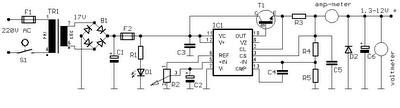
Power supply circuit to generate output below were variations between 1.3V DC to 12.2V DC with 1A current.
In addition, the power supply circuit is also equipped with over-current protection or shield against belebih flow. Power supply circuit is very simple, but the quality is quite good, made her basiskan regulator IC LM723 is a pretty legendary.


1.3V


Description:

R2 to set the output voltage. The maximum current is determined by R3, over-current protection circuit inside the LM723 to detect the voltage on R3, if it reaches 0.65 V, the voltage output will be off her. So the current through R3 can not exceed 0.65 / R3 although output short-circuit in his.

C3 and C4 are ceramic capacitors, as much as possible directly soldered to the PCB, this is because the LM723 is prone to oscillation that is not cool.

LM723 works with 9.5V input voltage to 40 V DC and the LM723 can generate its own current of 150mA when the output voltage is not more than 6-7V under input voltage.


Specifications:

Output (value estimated):

Vmin = (R4 + R5) / (R5 * 1.3)
Vmax = (7.15 / R5) * (R4 + R5)
Imax = 0.65/R3
Max. Power on R3: 0.42/R3


Min. DC Input Voltage (pin 12 to pin 7): Vmax + 5

Component List:

B1 40V/2.5A
C1 2200uF (3300uF even better)
C2 4.7uF
C3 100nF
C4 1NF
C5 330nF
C6 100uF
Green LED D1
D2 1N4003
F1 0.2A F
F2 2A M
IC1 LM723 (in a DIL14 plastic package)
R1 1k
R2 Pot. 5k
R3 0.56R/2W
R4 3.3k
R5 4.7k
S1 250V/1A
T1 2N3055 on a heatsink 5K / W
TR1 220V/17V/1.5

Tuesday, October 28, 2014

5 1 Classic Home Theater System Energy

Low Distortion and Resonance - spokesman method is distortion- otherwise resonance-without charge, but Energy has achieved a significantly decrease distortion level, a plainly audible perfection.


Classic

The Take Classic 5.1 home theater system also offers terrific performance and great features:

  • Our patented Convergent Source Module (CSM) 3-edge your way poly-titanium woofer and .75-inch hyperbolic aluminum-field tweeter -the kindness of Energy speakers
  • Patented corrugated Elliptical Surround woofers create from top to toe efficiency, low distortion
  • An aluminum auditorium tweeter on behalf of sonic accuracy
  • Front and rear venting for additional powerful low response
Take Classic raises the piece for 5.1 narrator classification performance. It includes a powerful 200-watt subwoofer with a front-firing seaport, 8-shuffle driver and wavy Elliptical Surround™ in support of deep with the intention of you feel when much as hear. The Convergent Source Module (CSM), with its 3-shuffle poly-titanium woofer and .75-inch hyperbolic aluminum-pitch tweeter, focuses sound for clearer dialogue and stirring melody. The CSM gives soundtracks a dynamic frequency range and a colossal soundstage, used for smooth, realistic sound from every one satellite lecturer and the base channel. song and motion picture lovers rejoice. Take Classic puts the passion back into your favorite films.
Exclusive Energy® Brand Technologies

Convergent Source Module
The Convergent Source Module, before CSM, provides broad dispersion, low distortion and amazing midrange performance. The lecturers midrange and tweeter are positioned inside close proximity to individual an alternative and accomplish seeing that a single source, by this means increasing overall dispersion and falling some lobing effect. The chambering of the middle and tweeter lowers the drivers resonance, plummeting distortion.

wavy Elliptical Surround knowledge
Energys patented ridged Elliptical Surround technology (U.S. patent #6,725,967, Canadian patent #2,407,123) increases excursion, eliminates distortion and raises efficiency on woofers and subwoofers. The Elliptical Surround encompasses the conduit, allowing it to move identically concerning both instructions, follow-on in come up to nil distortion. And while standard designs are often plagued with surround dimpling, which causes them to give off in and off of segment and distort on all listening levels, Energys designs arent influenced by dimpling on all, as a substitute proprietary grooved Elliptical Surround expertise allows representing a better conduit come up, resultant trendy greater efficiency. This design as well lets the conduit do greater crest to peak movement, in this way allowing it to travel added than bend in half the distance of the competition. These attributes enable Energy woofers and subwoofers to move incredible amounts of air, ultimately allowing them to joke about drop frequencies with greater low lean-to and fidelity.

come again?s voguish the Box
A 6-example, soaring spin black place of Energy Take Classic 5.1 speakers: 4-Take satellite speakers, 1-faultlessly matched Take interior channel spokeswoman, 1-perfectly matched Take powered subwoofer; 1-owners guide.

Technical Specifications
  • Frequency Response - Sat: 115Hz-20KHz; Center: 110Hz-20KHz; Subwoofer: 33Hz-150Hz +/- 3dB
  • Crossover purpose - 2.9 kHz
  • Sensitivity - 89dB
  • Power use - Sat & core: 100 Watts; Subwoofer: 200 Watts
  • Recommended Amplifier Power - 20 - 100 Watts RMS (permanent)
  • Impedance - 8-ohm compatible
  • Subwoofer adaptable Low Pass Filter - 40Hz-150Hz @ 18dB/octave
  • Tweeter - ¾-shuffle (19 mm) Hyperbolic™ aluminum-ground
  • Woofer - Sat & crux: 3-edge your way poly-titanium; junior: 8" IM cone-shaped tool with Patented grooved Elliptical Surround
  • Dimensions (inches) - Sat: 6 7/8 x 4 1/8 x 4 1/8; Center: 4 1/8 x 10 1/4 x 4 1/8; Subwoofer: 12 5/8 x 12 5/8 x 12 5/8 (add 2 1/6" pro feet)
  • power - Sat: 2.9 lbs; foundation: 3.2 lbs; Subwoofer: 19.7 lbs

Performance Tips: 
The center channel spokeswoman needs to be alive centrally located so so as to the dialogue appears to be approach from the center of the screen. It needs to be more than or else underneath the overseer, while faithfully to it as feasible. If youon the subject of using a rear projection television, the nearly all likely option is to place it over the screen. If you say a front projection method, you have choices-rack mounting, otherwise placement on furniture, in support of illustration. It is principal, though, to place the orator so to facilitate its front frame is even with the edge of the shelf or else stand underneath it. unsolicited diffraction occurs whilst the foundation channel is too far back into a cabinet or else other exterior with edges with the aim of possibly will impede sound dispersion.

In support of not here or else utterly front channels, the distance concerning the speakers be supposed to live 6-8 feet on smallest amount for the greatest stereo imaging. The optimum extent identity is rectangular, with the speakers along solitary of the shorter walls, facing the opposite margin. If probable, figure out not place speakers hostile to a fence or else by rear of a bookshelf; corner placement is generally the most evil option. Try to keep the speakers-especially rear vented models-next to smallest amount two feet from the plane behind it, save you manipulation a vent plug. pro superlative results mounting on a rear cage up, pose the speakers so they flank the major listening area and item with regard to the front of the opportunity. They be supposed to be situated raised to a height of approximately six feet and ought to ideally give a window of six feet involving them.

The three a good number normal subwoofer locations include corners (which can upshot taking part in boomy otherwise exaggerated low frequency response), placement along a mountain, away from the corner (producing moderate low performance with increased fidelity terminated corner placement), otherwise beside a front spokeswoman (creating a better blend with the front speaker, but sacrificing overall volume). Experimentation with subwoofer placement is highly encouraged; slight adjustments can create giant differences clothed in sound reproduction. To test subwoofer placement, install it in the short term in your chief listening attitude and march around the listening space while on stage a familiar bit of melody until you catch the most excellent sounding position.
Wednesday, September 24, 2014

How to Build 1 2 30V 1 5A Variable Regulated Power supply Circuit


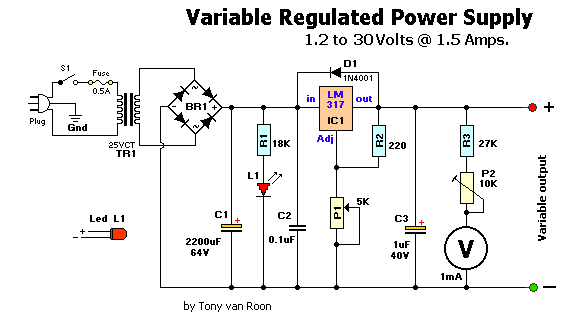
How to Build 1.2-30V/1.5A Variable Regulated Power supply, This is simple 1.2-30V/1.5A variable regulated power supply circuit diagram The 110V-AC coming from the powercord is fed to the transformer TR1 via the on-off switch and the 500mA fuse. The 30vac output (approximately) from the transformer is presented to the BR1, the bridge-rectifier, and here rectified from AC (Alternating Current) to DC (Direct Current). If you dont want to spend the money for a Bridge Rectifier, you can easily use four general purpose 1N4004 diodes. The pulsating DC output is filtered via the 2200µF capacitor (to make it more manageable for the regulator) and fed to IN-put of the adjustable LM317 regulator (IC1). The output of this regulator is your adjustable voltage of 1.2 to 30volts varied via the Adj pin and the 5K potmeter P1. The large value of C1 makes for a good, low ripple output voltage.

 1.2-30V/1.5A Variable Regulated Power supply Circuit Diagram

1.2-30V/1.5A Variable Regulated Power supply Circuit


Why exactly 1.2V and not 0-volt? Very basic, the job of the regulator is two-fold; first, it compares the output voltage to an internal reference and controls the output voltage so that it remains constant, and second, it provides a method for adjusting the output voltage to the level you want by using a potentriometer. Internally the regulator uses a zener diode to provide a fixed reference voltage of 1.2 volt across the external resistor R2. (This resistor is usually around 240 ohms, but 220 ohms will work fine without any problems). Because of this the voltage at the output can never decrease below 1.2 volts, but as the potentiometer (P1) increases in resistance the voltage accross it, due to current from the regulator plus current from R2, its voltage increases. This increases the output voltage.

D1 is a general purpose 1N4001 diode, used as a feedback blocker. It steers any current that might be coming from the device under power around the regulator to prevent the regulator from being damaged. Such reverse currents usually occur when devices are powered down.

The ON Led will be lit via the 18K resistor R1. The current through the led will be between 12 - 20mA @ 2V depending on the type and color Led you are using. C2 is a 0.1µF (100nF) decoupler capacitor to filter out the transient noise which can be induced into the supply by stray magnetic fields. Under normal conditions this capacitor is only required if the regulator is far away from the filter cap, but I added it anyway. C3 improves transient response. This means that while the regulator may perform perfectly at DC and at low frequencies, (regulating the voltage regardless of the load current), at higher frequencies it may be less effective. Adding this 1 µF capacitor should improve the response at those frequencies.

R3 and the trimmer pot (P2) alows you to zero your meter to a set voltage. The meter is a 30Volt type with an internal resistance of 85 ohms. I you have or obtained a meter with a different Ri (internal resistance) you will have to adjust R3 to keep the current of meter to 1mA. Just another note in regards this meter, use the reading as a guideline. The reading may or may not be off by about 0.75volts at full scale, meaning if your meter indicates 30 volts it may be in reality almost 31 volts or 29 volts. If you need a more precies voltage, then use your multimeter.


Construction:
Because of the few components you can use a small case but use whatever you have available. I used a power cord from a computer and cut the computer end off. All computer power cords are three-prong. The ground wire, which is connected to the middle pin of the power plug is connected to the chassis. The color of the ground-wire is either green or green/yellow. It is there for your protection if the 110vac accidentally comes in contact with the supply housing (case). BE CAREFUL always to disconnect the powerplug when you working inside the chassis. If you choose to use an in-line, or clip-type fuseholder be sure to isolate it with heat shrink or something to minimize accidental touching.

I use perf-board (or Vero board) as a circuit board. This stuff is widely available and comes relatively cheap. It is either made of some sort of fiber material or Phenolic or Bakelite pcb. They all work great. Some Phenolic boards come with copper tracks already on them which will make soldering the project together easier.

I mounted the LM317(T) regulator on a heatsink. If you use a metal/aluminum case you can mount it right to the metal case, insulated with the mica insulator and the nylon washer around the mounting screw. Note that the metal tab of the LM317 is connected internally to the Output pin. So it has to be insulated when mounting directly to the case. Use heat sink compound (comes in transparent or white color) on the metal tab and mica insulator to maximize proper heat transfer between LM317 and case/ or heatsink.

Drill the holes for the banana jacks, on/off switch, and LED and make the cut-out for the meter. It is best to mount everything in such a way that you are able to trouble-shoot your circuit board with ease if needed. One more note about the on-off switch S1, this switch has 110VAC power to it. After soldering, insulate the bare spots with a bit of silicon gel. Works great and prevents electrical shock through accidental touching.

If all is well, and you are finished assembling and soldering everything, check all connections. Check capacitors C1 & C3 for proper polarity (especially for C1, polarity reversal may cause explosion). Hookup a multimeter to the power supply output jacks. Set the meter for DC volts. Switch on S1 (led will light, no smoke or sparks?) and watch the meter movement. Adjust the potentiometer until it reads on your multimeter 15Volts. Adjust trimpot P2 until the meter also reads 15volts. When done, note any discrepancies between your multimeter and the power supply meter at full scale (max output). Maybe there is none, maybe there is a little, but you will be aware of it. Good luck and have fun building!


Parts List

BR1 = Bridge Rectifier, 100V - 3A       C1 = 2200 µF, 63V
IC1 = LM317, adjustable regulator       C2 = 0.1 µF
  V = Meter, 30V, Ri = 85 ohm           C3 = 1µF, 40V
TR1 = Transformer, 25V, 2A            Plug = 3-wire plug & cord
 R1 = 18K, 5%                           S1 = On-Off toggle switch
 R2 = 220 ohm, 5%                       D1 = 1N4001
 R3 = 27K, 5%                         Fuse = 110V, 500mA, slow-blow
 P1 = 5K, potentiometer               FuseHolder, wire, solder, case, knob for P1
 P2 = 10K, 10-turn trim-pot           Red & Black Banana Jacks

Notes:  
This is a simple, but low-ripple powersupply, and an excellent project if youre starting out in electronics. It will suit your needs for most of your bench testing and prototype applications. The output is adjustable from 1.2 volts to about 30 volts. Maximum current is about 1.5 amps which is also sufficient for most of your tinkering. It is relatively easy to build and can be pretty cheap if you have some or all the required parts. A printed circuit board is not included and Im not planning on adding one since the whole thing can easily be build on perferated or vero board. Or buy one of Radio Shack/Tandys experimentors boards (#276-150). Suit yourself. The meter and the transformer are the money suckers, but if you can scrounge them up from somewhere it will reduce the cost significantly. BR1 is a full-wave bridge rectifier. The two ~ denotes AC and are connected to the 25vac output coming from the transformer. IC1 is a 3-pin, TO-220 model. Be sure to put a cooling rib on IC1, at its max 1.5 A current it quickly becomes very hot..

All the parts can be obtained from your local Radio Shack or Tandy store. The physical size of the power supply case depends largely on the size of the meter & transformer. But almost anything will do. Go wild.


Sourced By  Tony  van roon

New Circuit Diagram 2 0 Beta 1 Released

This release includes a number of changes to make designing circuits easier, including automatic flipping of components when placing them and dragging from right to left or bottom to top. Documents can also be resized and there are many improvements to the use of keyboard shortcuts, including the ability to delete components by pressing the delete key on the keyboard.

Please see below for the full list of changes.

Windows Explorer Thumbnails

Thumbnails are now shown in Windows Explorer for Circuit Diagram Documents, as shown in the picture below. This feature has been difficult to get working, and there may be problems with the thumbnails not appearing - please leave a comment to let me know if they are working or not.

Explorer thumbnails

List of Changes

The following new features have been added since Circuit Diagram 2.0 Alpha 3:
  • Automatically flip components when placing
  • Delete components using keyboard delete key
  • Resize document
  • Document properties window
  • Print document
  • Recent files list
  • Confirm when exiting with unsaved changes
  • Thumbnail previews in Windows Explorer for CDDX files
  • Show shortcut keys in toolbox
  • Highlight selected item in toolbox
  • Zoom using mouse scroll wheel while holding down ctrl key
  • Plugin support for:
    • Custom export formats
    • Custom import formats
  • Open CDDX files created in Circuit Diagram 1.x
  • New components:
    • Voltmeter & ammeter
    • 4-bit counter
Please note that the .NET Framework 4.0 is now required.
You can download the new version here, and please get in touch using the forum if you have any questions about this new version. Link